
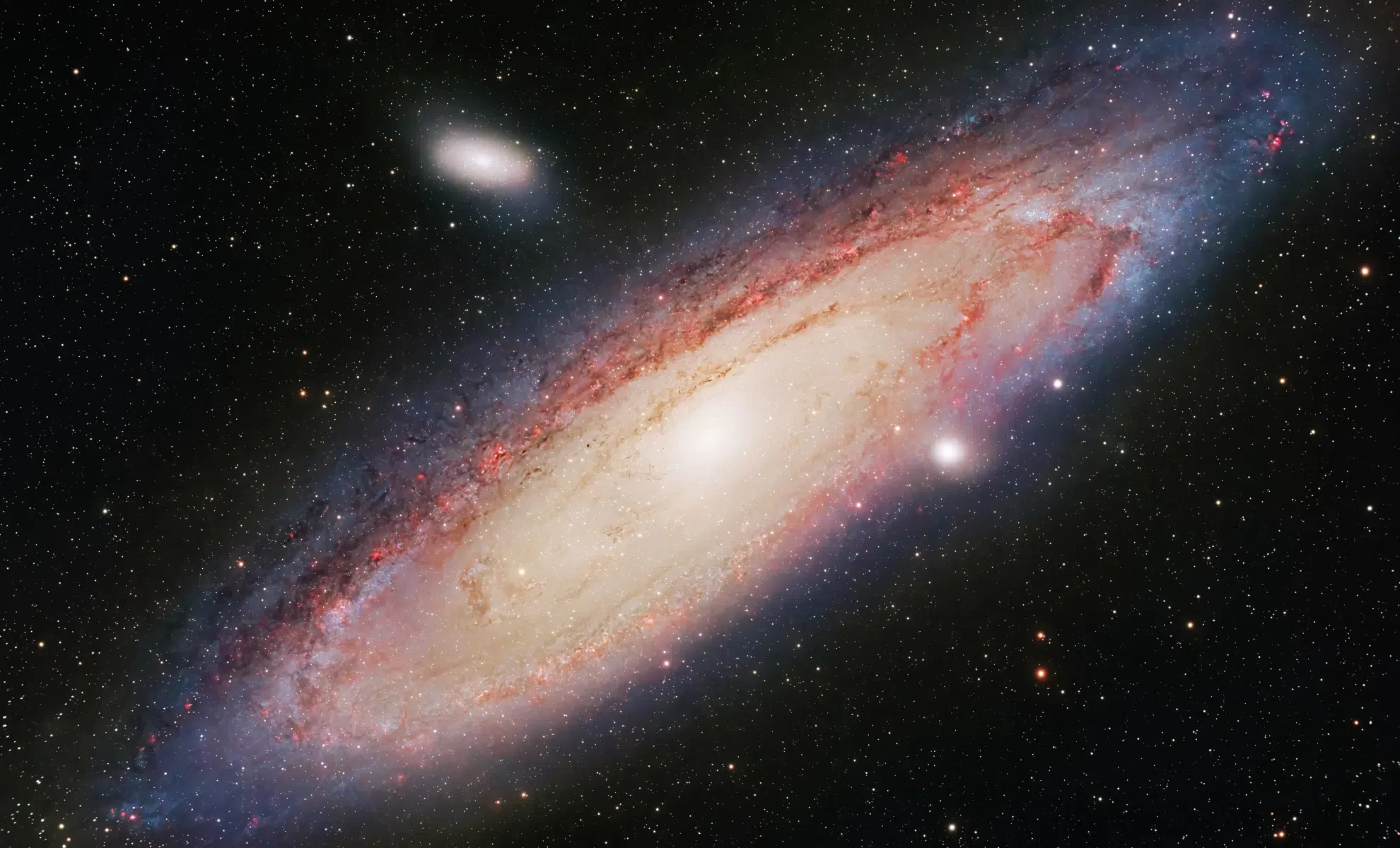
Why Is Andromeda Racing Toward the Milky Way?
Why Is Andromeda Racing Toward the Milky Way?
Written by: Keya Gambhir
Have you ever wondered what’s happening in space right next to our galaxy, the Milky Way? Our nearest big galactic neighbor, Andromeda, is actually speeding toward us at an astonishing 68 miles per second! That’s faster than a speeding rocket, and it means that in about 4 billion years, Andromeda and the Milky Way could collide. But why is it moving toward us while most other galaxies are moving away? Scientists have been trying to solve this cosmic mystery for decades.
The answer, it turns out, has a lot to do with something invisible called dark matter. Dark matter is a mysterious substance that we can’t see, but it has gravity and makes up most of the universe’s mass. It surrounds galaxies and helps hold them together. Recent research shows that Andromeda and the Milky Way are moving the way they do because of a giant, flat sheet of dark matter that stretches for tens of millions of light-years.
Most galaxies in the universe are following something called Hubble’s Law. This means that the farther a galaxy is from us, the faster it seems to be moving away. It’s like the universe is stretching, carrying galaxies apart. But Andromeda doesn’t follow this rule because the dark matter sheet is pulling it toward the Milky Way. This massive, flat layer of invisible matter has so much gravity that it can overcome the general expansion of the universe in our neighborhood.
Other nearby galaxies, farther from the dark matter sheet, are still moving away as expected. That’s because the sheet is like a cosmic trampoline: it pulls some galaxies in and pushes others out, depending on where they are. Scientists also noticed that there are huge empty areas in space called cosmic voids. These regions have very little matter, so the gravity from the surrounding walls of galaxies and dark matter is even stronger. This combination of voids and the dark matter sheet explains why Andromeda is the only nearby giant galaxy heading straight for us.
To figure all this out, astronomers ran detailed computer simulations of the universe. They started with the earliest moments after the Big Bang, tracking how matter and dark matter spread out over billions of years. The simulations showed that a flat layer of dark matter would naturally form around the Milky Way and Andromeda, influencing the motion of nearby galaxies. The results matched what we actually see in the sky today, confirming that dark matter is likely responsible for Andromeda’s approach.
So what does this mean for the future? When Andromeda and the Milky Way collide, it won’t be like a car crash in space. Most stars are very far apart, so they probably won’t smash into each other. Instead, the galaxies will slowly merge over billions of years, forming a huge new galaxy sometimes called Milkomeda. This cosmic dance will be guided by gravity, with dark matter playing a starring role behind the scenes.
Understanding Andromeda’s motion helps scientists learn more about dark matter and how galaxies interact. Even though we can’t see it, dark matter shapes the universe in amazing ways. Andromeda racing toward us is a reminder that space is full of surprises, and that there’s still so much left to discover about our universe.
The next time you look up at the night sky, imagine Andromeda slowly moving closer, pulled by invisible forces across millions of light-years. Thanks to dark matter, our cosmic neighborhood is much more exciting than it seems!
References
Amazouz, Lydia. 2026. “Andromeda Is Heading Straight for the Milky Way, and Scientists Finally Know Why.” The Daily Galaxy, February 7, 2026. https://dailygalaxy.com/2026/02/andromeda-heading-for-the-milky-way/.
Farkas, Ivan. 2026. “Every Major Galaxy Is Speeding Away from the Milky Way, Except One — and We Finally Know Why.” Live Science, February 6, 2026. https://www.livescience.com/space/cosmology/every-major-galaxy-is-speeding-away-from-the-milky-way-except-one-and-we-finally-know-why.
News Staff. 2026. “Milky Way’s ‘Central Black Hole’ Is Compact Object Composed of Fermionic Dark Matter, Study Says.” Sci.News, February 5, 2026. https://www.sci.news/astronomy/milky-ways-compact-object-fermionic-dark-matter-14537.html.