
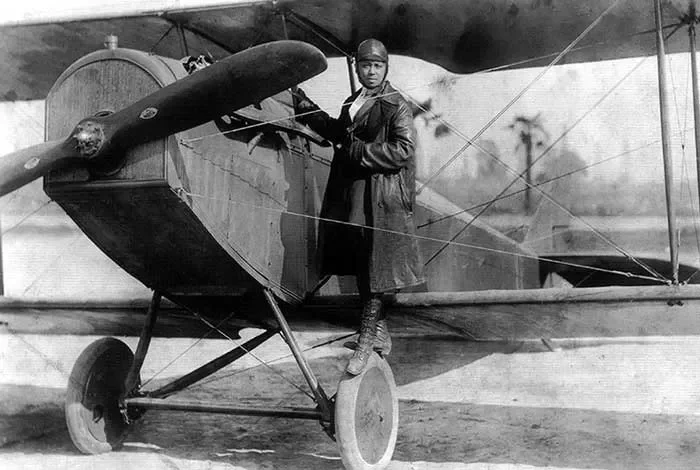
Bessie Coleman
Bessie Coleman
Written by: Paige Leal
Before she was known as “Queen Bess,” Bessie Coleman was a girl growing up in Texas with a big family and big dreams. Born on January 26, 1892, in Atlanta, Texas, she was one of thirteen children. Her family later moved to Waxahachie, where Bessie attended a segregated one-room schoolhouse. She loved learning, but her education was often interrupted because she had to help pick cotton during harvest season. Her mother worked hard to support the family, and Bessie learned that life would not always be easy.
As a young adult, Bessie moved to Chicago and worked as a manicurist. Her life took a turn when her brother returned from World War I and told her stories about women in France who flew airplanes. Bessie decided she wanted to become a pilot herself. There was one major problem: American flight schools would not accept her because she was both Black and a woman. Instead of giving up, Bessie stuck to her dream. She learned French, saved her money, and traveled to France to study aviation.
In 1921, Bessie earned her international pilot’s license, becoming the first African American woman to do so. She returned to the United States and became a stunt pilot, performing risky tricks such asloops and barrel rolls in front of crowds. People were amazed by “Brave Bessie,” who became known as “Queen Bess.”
Bessie did not want her accomplishments to be only about herself. She hoped to open a flight school for Black students so others could have the opportunities that had been denied to her. She spoke to audiences and encouraged African Americans, especially women, to pursue aviation. Bessie stood up against segregation, too. She refused to perform at air shows that made Black and white spectators use separate entrances. She wanted everyone to have the chance to watch her fly.
Sadly, Bessie's life was cut short. On April 30, 1926, she died at age 34 during a flight rehearsal in Florida. Her dream of opening a flight school was never completed, but her influence did not end there. She inspired generations of Black pilots and showed that the sky did not have to be off-limits because of someone's race or gender. Today, her story is remembered through honors like a U.S. postage stamp and a quarter featuring her image. Bessie Coleman proved that one person's determination can help change what others believe is possible.
References
Mathias, Marisa. “Bessie Coleman.” National Women's History Museum. https://www.womenshistory.org/education-resources/biographies/bessie-coleman. Accessed November 15, 2026.
“Bessie Coleman, First African American Woman to Earn a Pilot's License.” National Air and Space Museum, Smithsonian Institution. https://airandspace.si.edu/explore/stories/bessie-coleman. Accessed November 15, 2026.
St. Fleur, Nicholas. “Bessie Coleman.” National Geographic Kids. https://kids.nationalgeographic.com/history/article/bessie-coleman. Accessed November 15, 2026..