
Healthy Corals Are Helping Bleached Corals Recover
Healthy Corals Are Helping Bleached Corals Recover
Written by: Keya Gambhir
Coral reefs around the world are turning white as ocean temperatures rise, putting thousands of marine species at risk. But scientists at Stanford University have discovered a surprising way to help some damaged corals recover: letting them touch healthy corals!
Their discovery, published in the scientific journal Science Advances in October 2026, could open new possibilities for restoring coral reefs damaged by climate change.
Why Are Corals Turning White?
Corals are tiny animals that live together in groups to form large structures called coral reefs. These reefs provide homes for many marine animals, including fish, crabs, and sea turtles. They also help protect coastlines from powerful waves and storms.
But coral reefs face a serious threat called coral bleaching.
Inside coral tissues live microscopic algae, which are tiny organisms that use sunlight to produce food. The corals provide the algae with shelter, while the algae supply much of the energy the corals need to survive. When ocean water becomes too warm, corals can become stressed and push these algae out of their bodies.
Without their algae partners, corals lose their color and turn white. They also lose an important source of food, leaving them weak and more likely to die.
Some corals can recover if the water cools down quickly enough. However, repeated heat waves can prevent them from recovering between bleaching events. As climate change causes ocean temperatures to rise, scientists are searching for ways to help reefs survive. Learn more about coral bleaching here.
A Surprising Discovery in the Lab
The Stanford scientists did not originally plan to discover this unusual recovery method.
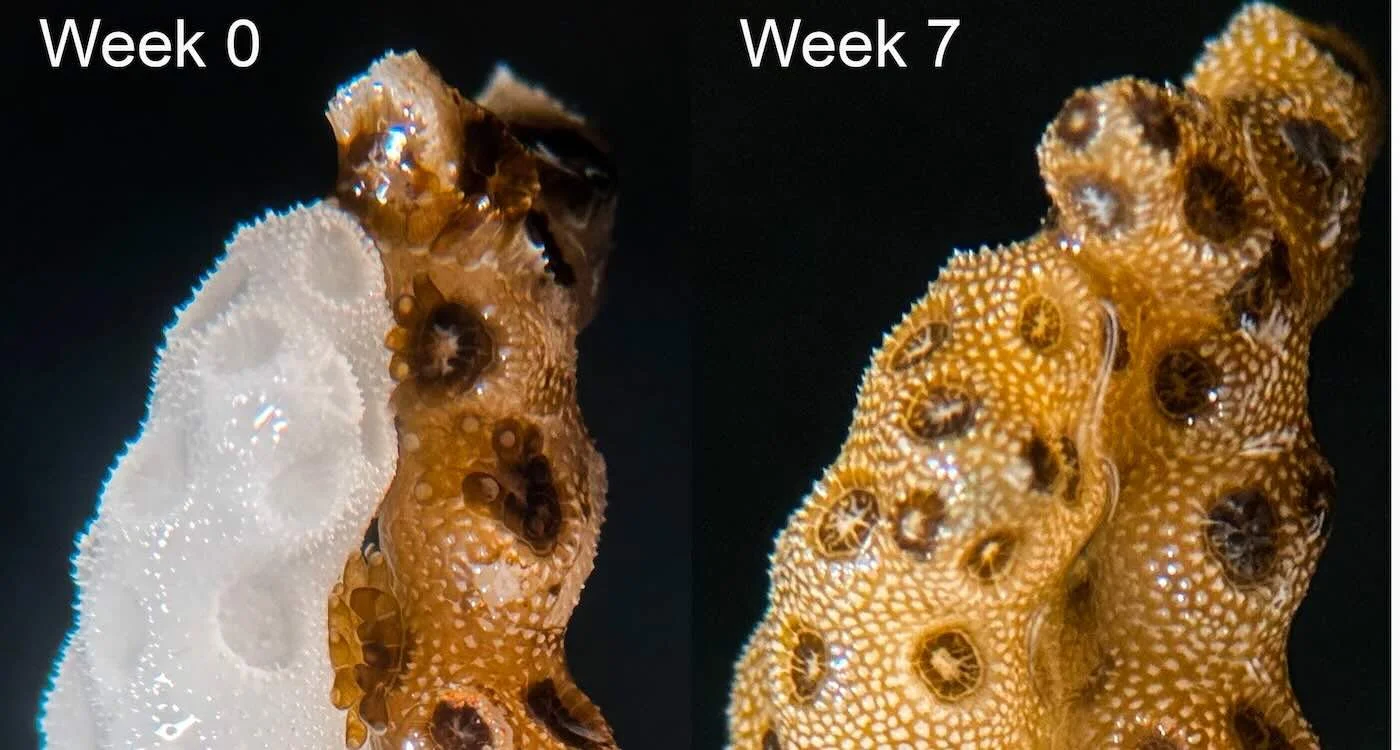
In 2025, Professor Steve Palumbi noticed something strange in a laboratory tank. A healthy piece of coral had fallen against a bleached piece. Where the two pieces touched, the bleached coral was beginning to regain its color.
This observation inspired doctoral student Danny Collins and his colleagues to investigate whether physical contact could help damaged corals recover.
The researchers tested small pieces of a coral species called Pocillopora damicornis, also known as cauliflower coral. They placed healthy and bleached coral fragments either directly against each other or just a few millimeters apart.
The results were remarkable. All five bleached coral fragments that touched healthy coral recovered within seven weeks. In comparison, the bleached fragments kept apart died during the experiment.
How Does Touching Help?
Scientists discovered that the coral fragments could fuse together when they had the same genetic makeup. This means they shared the same genes, similar to identical twins.
After the fragments touched, tiny channels formed between their tissues. These channels allowed beneficial algae and nutrients to travel from the healthy coral into the bleached coral.
The algae began moving between the corals within just three days. After about five days to one week, some bleached fragments had received enough algae to continue recovering without staying connected to their healthy partners.
Even more surprisingly, the algae began multiplying extremely quickly inside the recovering corals. During the second week, their numbers doubled approximately every four days. That is about ten times faster than the growth rate observed in wild corals!
This rapid growth helped the damaged corals regain their color and recover much faster than they might in nature.
Can This Save Coral Reefs?
Although the discovery gives scientists hope, there are still major challenges.
First, the experiment only tested one coral species. Scientists do not yet know whether the same method will work for other types of coral.
Second, the coral fragments needed to be genetically identical to fuse successfully. Finding a healthy genetic copy for every damaged coral in the ocean would be extremely difficult. Researchers are now exploring other ways to deliver beneficial algae without requiring corals to touch.
Most importantly, this method helps corals recover after bleaching, but it does not protect them from rising ocean temperatures. Scientists warn that reducing greenhouse gas emissions, which contribute to global warming, remains essential to protecting coral reefs.
A Little Contact, A Lot of Hope
Coral reefs support marine life, protect coastal communities, and make our oceans more diverse. Losing them would affect both animals and people.
The Stanford discovery shows that even a small interaction between two organisms can reveal something important about nature. By learning how healthy corals help damaged ones, scientists may develop better ways to restore reefs in the future.
There is still much work to do, but these findings remind us that bleached corals may have a chance to recover. With continued research and efforts to slow climate change, we can help give coral reefs a brighter future.
References
Good News Network. 2026. “Coral Bleaching Reversed at Record Speed Using New Stanford Method: ‘Not a Lost Cause, at All.’” October 17, 2026. https://www.goodnewsnetwork.org/coral-bleaching-reversed-at-record-speed-using-new-stanford-method/.
Saueurs, Craig. 2026. “‘They’re Not Dead Yet’: Bleached Corals Recover in Record Time after Touching Healthy Clones.” Euronews, October 15, 2026. https://www.euronews.com/2026/10/15/theyre-not-dead-yet-bleached-corals-recover-in-record-time-after-touching-healthy-clones.
Zhong, Raymond. 2026. “To Heal These Bleached Corals, All It Took Was a Little Touch.” The New York Times, October 14, 2026. https://www.nytimes.com/2026/10/14/climate/coral-bleaching-healing-touch.html.