
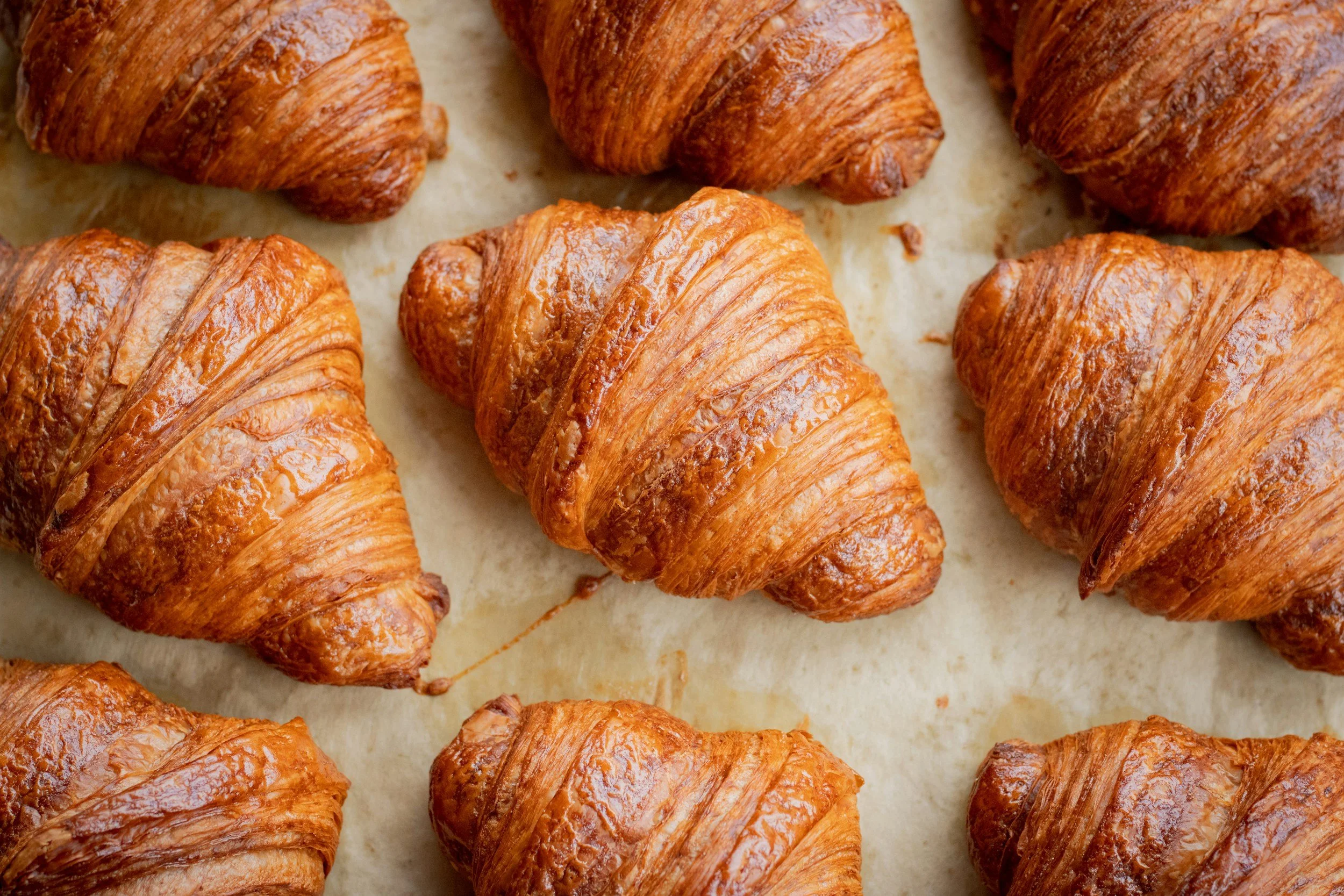
Golden Croissants
Golden Croissants
Written by: Natalie Yao
History
When you think of a croissant nowadays, you think of a flaky, buttery French pastry. But did you know that the origin of the croissant isn’t actually from Austria? The Austrian pastry is called kipferl and the French used it to develop the croissant that you think of today. The kipferl actually dates back to the 13th century, in the Middle Ages. Unlike the French pastry, the kipferl is much denser and thinner, but like the croissant contains large amounts of butter and sugar, and is also a crescent shape.
There are many myths surrounding the origins of the kipferl and the croissant and how it got from Vienna to Paris. One myth on the origin of the kipferl was that it was created in the 17th century after the Austrians fought off the Ottomans in their siege of Vienna. As for how the concept of the croissant was brought to Paris, there is a myth stating that Marie Antoinette had brought the kipferl from Vienna when she had moved to marry King Louis XVI in the 1700s. In reality, the delicacy was actually brought to France by August Zang, Viennese business owner, who opened up an Austrian bakery in Paris during the early 19th century. The crescent shape of Zang’s kipferls led to the French naming their version croissant, which directly translates to crescent.
How to Make Croissants
Making croissants is widely regarded as a difficult and long process, as it takes multiple days to prepare the dough. First, the dough is made by mixing flour, sugar, yeast, salt, milk, and a bit of butter and then kneading the dough until it is smooth, then placing it in the refrigerator overnight. The purpose of this is to help the dough develop flavor and slow the yeasts’ growth process. Next, a butter block is formed, done by pounding cold butter into a thin square, and it is placed in the dough by folding it over the block. Then roll the dough out and fold it again, and repeat this process a couple of times and refrigerate in between so the butter doesn’t melt. This is to create layers, which is what gives croissants a flaky texture. After the dough is all prepared, it is rolled out and cut into long triangles which are then rolled from base to tip to create the round shape of the pastry. The shaped croissants are then set on the counter to expand, and after that egg wash is placed on them to then bake at a high heat. After they are done baking, they are ready to eat, and can be paired with jams, fruits, tea, coffee, or hot cocoa.
Different Types of Croissants
Croissant au beurre (the traditional butter croissant)
Pain au chocolat (chocolate croissant)
Almond croissant
Ham and cheese croissant
References
Europeana. 2024. “The History of the Croissant.” https://www.europeana.eu/en/stories/the-history-of-the-croissant
Paris Unlocked. 2024. “History of the Croissant: How France Adopted It.” https://www.parisunlocked.com/food/food-history/history-of-the-croissant-how-france-adopted-it/
Puratos. 2023. “The Curious History of the Croissant.” https://www.puratos.us/en/blog/the-curious-history-of-the-croissant