
NASA’s First Moon Mission in Over 50 Years
NASA’s First Moon Mission in Over 50 Years
Written by: Keya Gambhir
More than 50 years after humans last traveled to the moon during the Apollo missions, NASA is finally getting ready to go back. The last time astronauts visited the moon was in 1972, making Artemis II the first mission in over half a century to send humans that far into space again. This is why the mission is such a big deal.
Unlike the Apollo astronauts, who actually landed on the moon, the Artemis II crew will not land or orbit it. Instead, they will fly around the moon and come back to Earth. Even without landing, their journey will take them farther into space than any humans have traveled before, giving them new views of the far side of the moon.
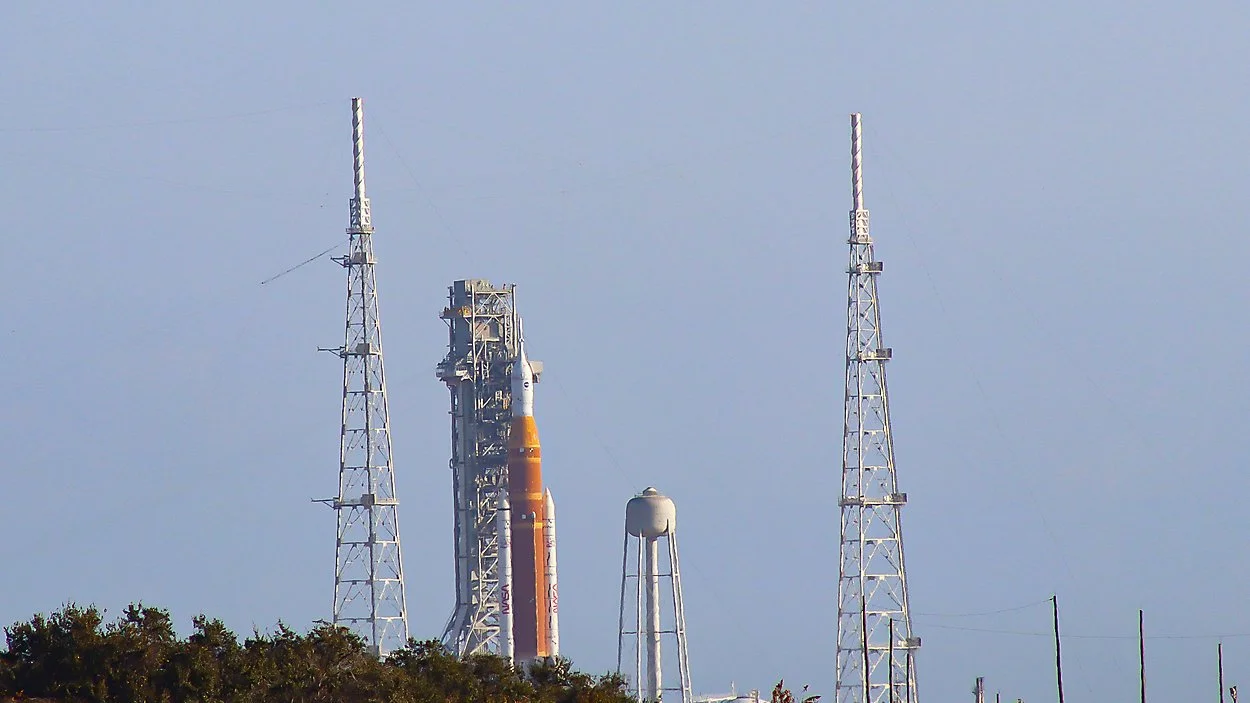
The launch is currently planned for April 1, with a two-hour window starting at 6:24 p.m. ET. The astronauts will take off from Kennedy Space Center in Florida aboard a giant rocket called the Space Launch System. This rocket is about 322 feet tall, which is taller than the Statue of Liberty and one of the most powerful rockets ever built.
The mission will last about 10 days. During that time, the crew will first orbit Earth, then travel to the moon and pass about 4,000 to 6,000 miles above its surface. At one point, they will go behind the moon, where they will temporarily lose communication with Earth for up to 50 minutes. From their spacecraft windows, they will see the moon up close and Earth far away in the distance, something very few humans have ever seen.
The spacecraft they will travel in is called Orion. It is designed to carry four astronauts in a small space about the size of a large room. The crew has trained to live closely together, eating, sleeping, exercising, and using a special space toilet during the trip. To stay healthy, they will exercise for about 30 minutes each day, even while floating in space.
One big difference between Artemis II and the old Apollo missions is the astronauts themselves. The Apollo crews were all white men, mostly military test pilots. The Artemis II team is much more diverse and shows how space exploration has changed over time.
The mission is led by Commander Reid Wiseman, a former Navy captain who has already spent months in space. The pilot is Victor Glover, who hopes his journey will inspire others. Another crew member is Christina Koch, who holds the record for the longest single spaceflight by a woman. The fourth astronaut is Jeremy Hansen from Canada, and this will be his first time in space.
Artemis II is also a test mission. NASA wants to make sure everything works before future missions that may land astronauts on the moon again. The rocket and spacecraft were first tested during the Artemis I mission in 2022, when Orion traveled farther from Earth than any spacecraft built for humans and safely returned.
Engineers have spent years improving the spacecraft, especially its heat shield, which protects it when it returns to Earth at very high speeds and temperatures. After Artemis I, scientists found problems and worked to fix them by changing how the spacecraft would re-enter the atmosphere.
The Artemis program has taken many years to develop, with delays and challenges along the way. But its goal is much bigger than one mission. In the future, astronauts may live and work on the moon and use what they learn to travel to Mars.
If Artemis II is successful, NASA will move closer to landing humans on the moon again. After more than 50 years, humans are finally returning, opening a new chapter in space exploration.
References
Dunn, Marcia. 2026. “Meet the Artemis Crew in NASA’s First Astronaut Mission to the Moon in More Than a Half-Century.” Associated Press, March 28, 2026. https://apnews.com/article/nasa-moon-artemis-crew-3a47786c3757f7d79154d96933aa5bd9
Chow, Denise. 2026. “NASA’s Giant Moon Rocket, in Photos.” NBC News, March 28, 2026. https://www.nbcnews.com/science/space/nasa-artemis-ii-moon-rocket-astronaut-photos-rcna255622
Leone, Anthony. 2026. “NASA to Launch Artemis II Crew in Flyby Mission to the Moon.” Spectrum News 13, March 27, 2026. https://mynews13.com/fl/orlando/space/2026/03/27/nasa-artemis-ii-launch-attempt-1