
The Great Depression: Tough Times in America
The Great Depression: Tough Times in America
Written by: Keya Gambhir
Have you ever heard the word depression and thought it only meant feeling sad? In history, the Great Depression was a time when millions of people around the world had a very hard time, not just emotionally, but with money, jobs, and food. It started in the United States in 1929 and lasted about ten years, until 1939.
The Great Depression began after a day called Black Thursday, when the stock market crashed. People had invested a lot of money in companies, and suddenly, many of them lost everything. Banks closed, and people could not get their money back. Businesses shut down because they could not sell their products, and millions of workers lost their jobs. At its worst in 1932, unemployment reached 23.6 percent, meaning almost one out of every four workers could not find a job. Earlier, in 1931, it was 15.9 percent, and in 1930 it was 8.7 percent, a huge jump from 3.2 percent in 1929.
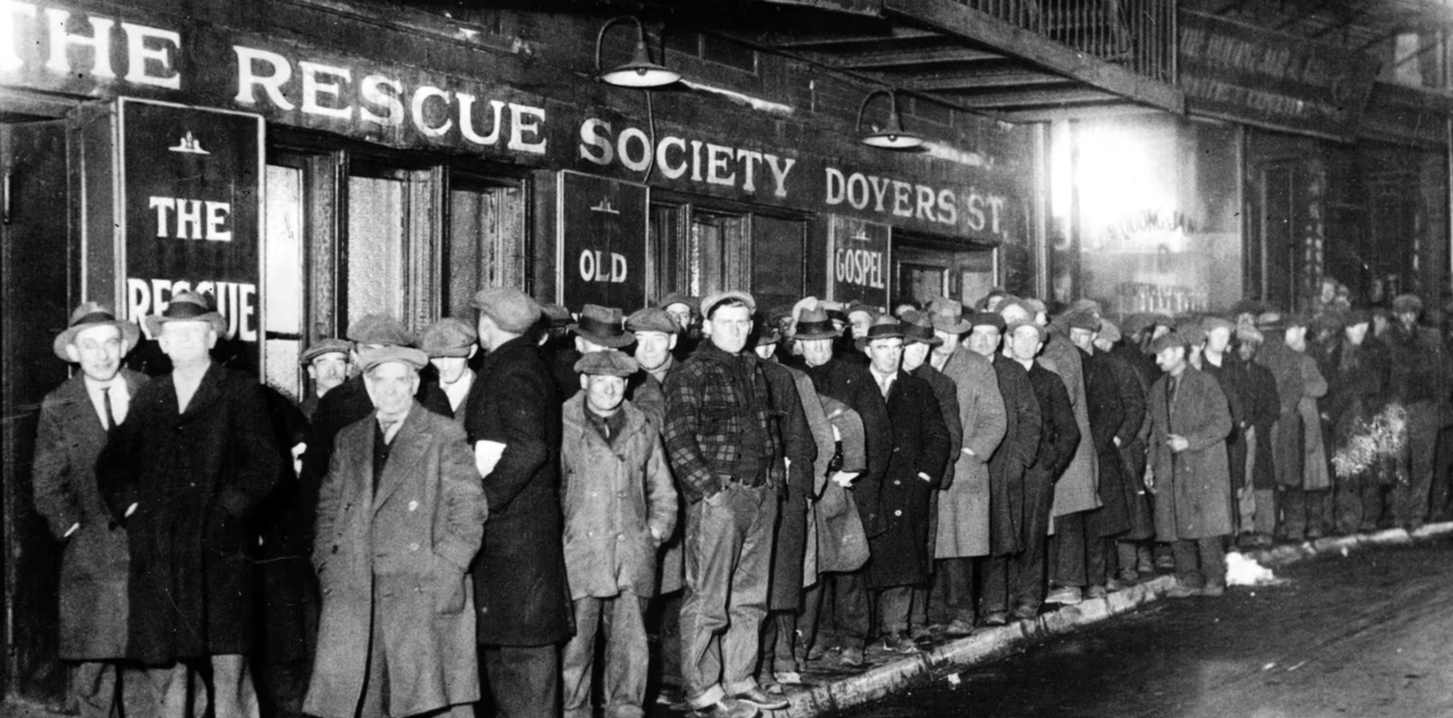
Life during the Great Depression was very hard for families. Many could not afford to buy enough food. Soup kitchens, which were places where people could get free meals, became common in cities. Some families lost their homes and had to live in tents or small shacks, often in groups called “Hoovervilles,” named after President Herbert Hoover. Farms were hit hard, too, especially in the Midwest, where huge dust storms destroyed crops. This event, called the Dust Bowl, forced many families to move to other states, especially California, in search of work.
The Great Depression was not just in the United States. Other countries also suffered, but some were affected more than others. Europe and Germany faced big economic problems, while Japan and countries in Latin America had a milder downturn. One reason the depression spread worldwide was the gold standard, which tied the value of money to gold and made countries’ economies depend on each other.
The crash caused psychological trauma for Americans. People felt guilt, shame, fear, and confusion. Many were afraid to open the door when someone came by. Parents looked embarrassed and even desperate. Children sometimes saw their parents cry for the first time. Some families had to sell cars, wedding rings, or even steal from piggy banks just to survive. Tragically, the stress caused some people to commit suicide.
Even well-educated people struggled. For example, one-third of Harvard’s Class of 1911 was living in poverty by 1932. Most companies reduced wages by 90 percent, and average family wages dropped by 40 percent. By 1932, 75 percent of workers were working part-time. Many small businesses shut down, and major companies like US Steel laid off every full-time worker.
The government tried to respond, but not always successfully. President Hoover used laissez-faire policies, meaning he did not directly intervene in the economy. Bank runs were another major problem. Before the Depression, there was no FDIC, so when people rushed to withdraw their money, thousands of banks failed, leaving 9 million families with no savings.
When Franklin D. Roosevelt became president in 1933, he created the New Deal, a series of programs to help people get jobs and support families. Some programs built roads, bridges, and schools, giving millions of people work. The Social Security Act, passed in 1935, provided money to older people and helped unemployed and disabled Americans for the first time. Roosevelt did not fully end the Depression, but he gave Americans hope and kept the country going until World War II, when manufacturing for the war finally restored the economy.
African Americans faced extra challenges, as many relief programs excluded them or treated them unfairly. Still, leaders like Mary McLeod Bethune, part of Roosevelt’s “Black Cabinet,” worked to ensure African Americans had a voice in government. Women also played a bigger role during this time. With men losing jobs, many women went to work in teaching, nursing, and secretarial jobs. First Lady Eleanor Roosevelt pushed for more women in government jobs, too.
The Great Depression taught the world many lessons about money, jobs, and government. Even though it was a very hard time, people found ways to help each other. Families shared what little they had. Communities built soup kitchens, and neighbors helped neighbors. Photographers like Dorothea Lange captured families, workers, and children struggling but also working together to survive. Their photos remind us that even in tough times, hope, courage, and community can make a big difference.
References
HISTORY.com Editors. 2009. “Great Depression History.” History, October 29, 2009. Last updated December 1, 2025. https://www.history.com/articles/great-depression-history
Pells, Richard H. n.d. “Great Depression.” Encyclopedia Britannica. Accessed December 5, 2025. https://www.britannica.com/event/Great-Depression