
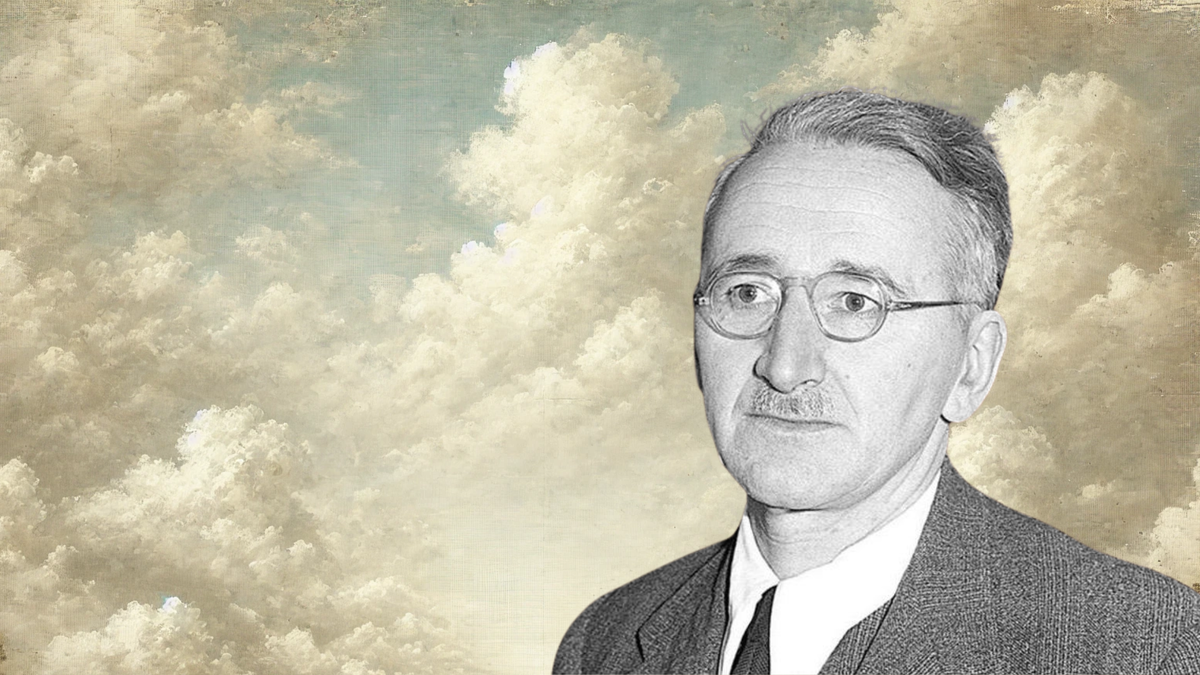
Friedrich Hayek
Here is a question almost nobody stops to ask. Who is actually in charge of the economy? Think about it. Nobody calls the bakery each morning to say how many loaves of bread your town will need. No boss tells farmers how much wheat to grow or truck drivers where to deliver it. And yet, somehow, when you walk into a store, the bread is almost always there. How does that happen with nobody running the whole show?
One of the most famous answers came from an economist named Friedrich Hayek, and it is one of the most mind-bending ideas in all of economics.
Meet Hayek
Friedrich Hayek was born in Vienna, Austria, in 1899, and he lived a long life, right up until 1992. He witnessed some of the most dramatic events of the twentieth century, including two world wars, which shaped how he thought about governments, freedom, and the economy. In 1974, he won the Nobel Prize in Economics for his work. His biggest idea was deceptively simple: no single person, and no government, can ever know enough to run an entire economy.
Nobody knows how to make a pencil
That sounds strange, so here is a famous example. Think about an ordinary pencil. Simple, right? Now try to actually make one, completely by yourself, from scratch. You would need to chop down a specific kind of tree for the wood, mine graphite for the center, dig up metal for the little band, grow rubber for the eraser, and mix chemicals for the paint. Then you would have to turn all of it into a pencil.
Here is the amazing truth: not a single person on Earth knows how to do all of that alone. A pencil only exists because thousands of people, loggers, miners, factory workers, and truck drivers who have never met and never will, somehow work together to make it. And nobody stands above them giving orders. So what pulls off this incredible team effort? Hayek’s answer was something you see every day: prices.
Prices are secret messages
Hayek’s great insight was that prices are not just numbers on a tag. They are messages, quietly carrying information to millions of people at once.
Imagine a surprise heat wave rolls in and suddenly everyone wants lemonade. Lemons start running low, so their price goes up. Now watch what that rising price does, all on its own. It tells shoppers, “lemons are scarce right now, so use them carefully.” At the very same time, it tells farmers far away, “people really want lemons, so grow more and you will earn more.” Those farmers might have no idea a heat wave even happened, and they do not need to. The price told them everything they needed to know. Nobody was in charge, yet the whole system adjusted itself.
Hayek called this kind of organization that nobody designed “spontaneous order.” It is order that appears all by itself, the way thousands of strangers end up cooperating without a single boss. To him, that was the real magic of a market.
Why Hayek worried about too much control
Because he believed knowledge is scattered across millions of people, Hayek was cautious about governments trying to plan and control an entire economy. In 1944 he wrote a famous book warning that when too much power over the economy piles up in one place, it can slowly chip away at people’s freedom. His point was not that governments are bad. It was that no planner, no matter how smart, can gather all the scattered knowledge that prices pull together automatically. Trying to replace that, he argued, usually causes more harm than good.
Hayek vs. Keynes
If this reminds you of the Keynes debate, good catch. Hayek and John Maynard Keynes were two of the most famous economists of the same era, and they were rivals who respectfully disagreed for years. Keynes believed that in a crisis, the government should step in and spend money to rescue the economy. Hayek worried that governments simply could not know enough to fix things from the top, and that stepping in too much might create brand new problems later. They were even friendly with each other, which makes their long disagreement one of the most famous rivalries in the history of economics.
So who was right?
As with most big economics questions, the honest answer is that people still argue about it, and both thinkers left a huge mark on the world. Some leaders and countries have leaned toward Hayek’s trust in free markets, while others have leaned toward Keynes’s belief in an active government. Most places, in reality, mix a little of both.
So the next time you walk into a store and find exactly what you were looking for, remember that no one ordered it to be there just for you. Millions of strangers, guided by nothing more than prices, quietly worked together to make it happen. Hayek spent his whole life studying that quiet miracle, and thanks to him, we understand it a little better.
Friedrich Hayek
Written by: Anders Lee
References
“F.A. Hayek.” Encyclopaedia Britannica, www.britannica.com/money/F-A-Hayek. Accessed 9 Oct. 2026.
“Friedrich August von Hayek.” Britannica Kids, Encyclopaedia Britannica, kids.britannica.com/students/article/Friedrich-August-von-Hayek/325956. Accessed 9 Oct. 2026.
“Friedrich Hayek.” Stanford Encyclopedia of Philosophy, Stanford University, plato.stanford.edu/entries/friedrich-hayek/. Accessed 9 Oct. 2026.