
The Ice Age: A Frozen Adventure Through Time
The Ice Age: A Frozen Adventure Through Time
Written by: Keya Gambhir
Imagine a world covered in thick ice, where glaciers stretch as far as the eye can see and giant animals roam the land. That was life during the Ice Age! Ice ages are periods in Earth’s history when global temperatures drop and huge sheets of ice, called glaciers, cover large areas of land. These icy periods can last millions of years and completely reshape the planet.
Earth has experienced at least five major ice ages: the Huronian, Cryogenian, Andean-Saharan, Karoo, and Quaternary. Each of these ice ages occurred at different times in history and left lasting marks on the land. The Quaternary Ice Age is the one we’re still technically living in today, although we are in a warmer period called the interglacial, when glaciers shrink, and the climate is milder.
Ice ages happen when Earth gets colder for long periods. Scientists believe this can be caused by changes in Earth’s orbit around the Sun, which affects how much sunlight reaches the planet. Other factors, like dust in the air, fewer greenhouse gases, or even shifts in the continents caused by plate tectonics, can also cool the planet. During these colder times, the snow doesn’t fully melt. Over the years, the bottom layers compress into ice, forming glaciers that slowly creep across the land. This ice traps water from oceans, lowering sea levels and changing the landscape.
The most recent Ice Age began about 2.5 million years ago and had glaciers that sometimes spread over all of Canada, much of the United States, northern Europe, and parts of South America. At the peak, around 18,000 years ago, the ice sheets were more than 12,000 feet thick! Sea levels dropped more than 400 feet, and global temperatures were up to 10 degrees Fahrenheit colder on average, with some areas even 40 degrees colder. In North America, areas that are warm today, like the Gulf Coast, were covered in pine forests and prairie grasses.
Glaciers didn’t just cover the land; they reshaped it. As they moved, they picked up rocks, soil, and gravel, carved out valleys, flattened hills, and created enormous lakes when they melted. Land bridges appeared where oceans had receded, allowing humans and animals to migrate to new areas. The sheer weight of glaciers pressed down on the Earth’s crust, which slowly rose back up after the ice melted.
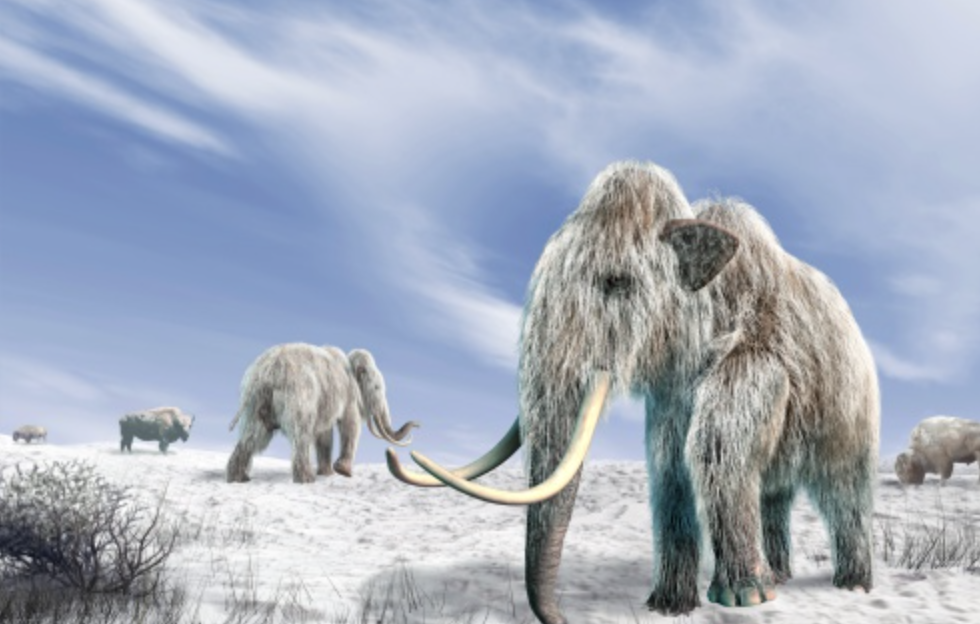
Humans were also adapting during this icy time. Early humans, called Homo sapiens, survived the harsh conditions by developing tools and strategies. They sewed warm clothing using bone needles, hunted for food, and explored new regions using the land bridges exposed by low sea levels. By the start of the warmer Holocene epoch, humans were ready to farm, domesticate animals, and settle in new areas. Meanwhile, giant Ice Age animals, like woolly mammoths, woolly rhinoceroses, mastodons, saber-toothed cats, and giant ground sloths, went extinct. Scientists are still studying why these animals disappeared, but human hunting, diseases, and climate change all likely played a role.
The idea of the Ice Age was first popularized by 19th-century Swiss geologist Louis Agassiz. He noticed glaciers in the Alps had left behind rocks and sediment, proving that ice once covered large parts of Earth. Later, Serbian mathematician Milutin Milankovitch discovered that changes in Earth’s orbit, tilt, and wobble affect how much sunlight the planet receives, helping to explain the cycles of ice ages. Together, these studies showed that ice ages are not just random; they follow patterns shaped by Earth and space.
Ice ages are fascinating because they show how the Earth can change over time and how life adapts to survive. They remind us of the power of glaciers, the creativity of humans, and the incredible diversity of animals that once roamed our planet. From freezing temperatures to massive ice sheets and giant mammals, the Ice Age was a frozen adventure that shaped the world we live in today.
References
Encyclopædia Britannica, Inc. 2026. “Ice Age.” Accessed January 31, 2026. https://kids.britannica.com/kids/article/ice-age/353280.
Fun Kids Live. n.d. “Top 10 Facts About The Ice Age!” Accessed January 31, 2026. https://www.funkidslive.com/learn/top-10-facts/top-10-facts-about-the-ice-age/.
HISTORY.com Editors. 2025. “Ice Age.” Accessed January 31, 2026. https://www.history.com/articles/ice-age.
Ray, Louis L. 1992. The Great Ice Age. U.S. Geological Survey General Interest Publication 7000022. Washington, D.C.: U.S. Government Printing Office. Accessed January 31, 2026. https://pubs.usgs.gov/gip/ice_age/ice_age.pdf.