
Antarctica’s Blue Giant Faces Its Last Days
Antarctica’s Blue Giant Faces Its Last Days
Written by: Keya Gambhir
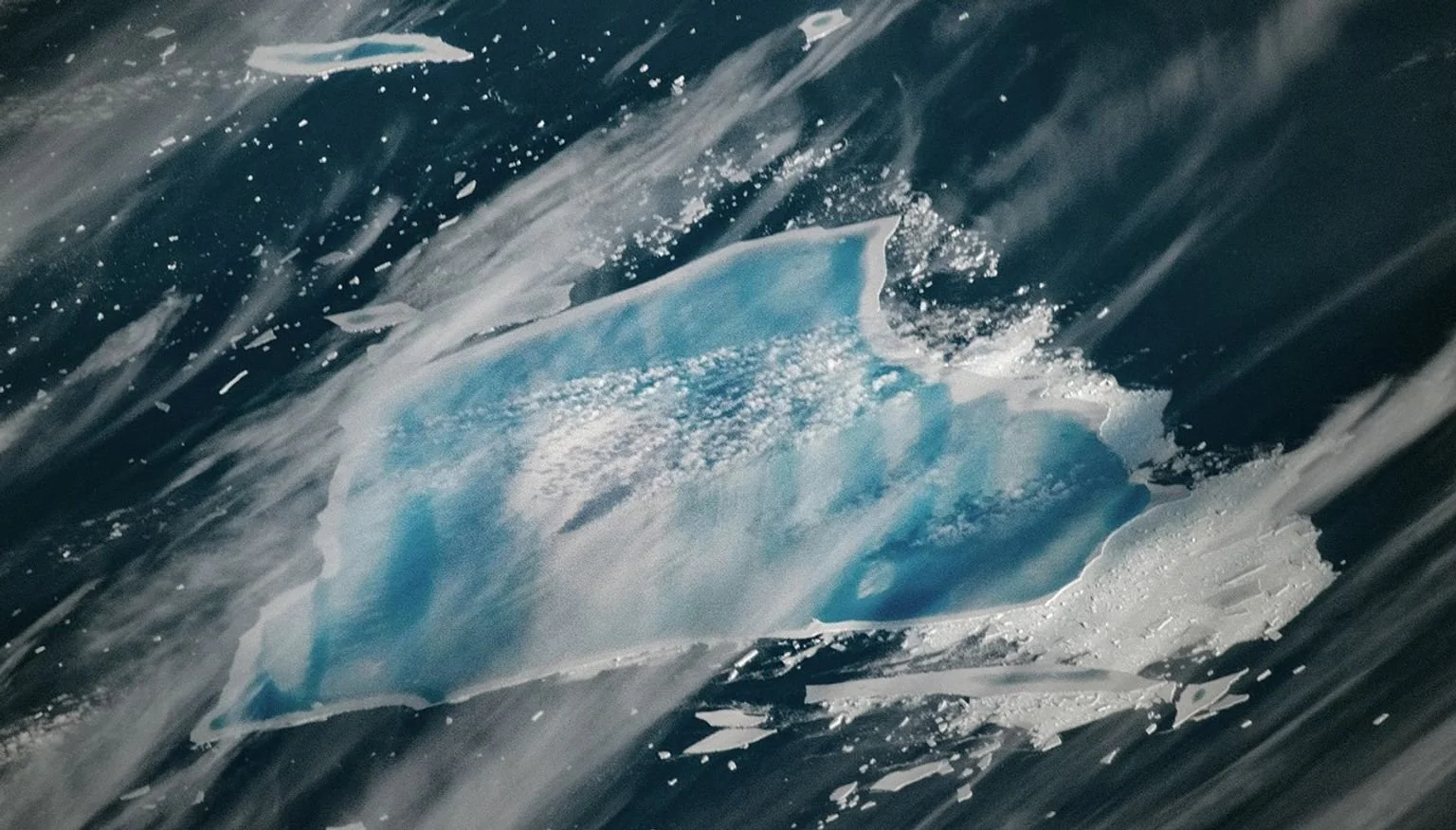
Far in the Southern Ocean, a massive iceberg named A-23A is slowly breaking apart, and scientists around the world are watching closely. This iceberg is no ordinary block of ice; it has been drifting for over 40 years, and at its peak, it was one of the largest icebergs ever tracked, bigger than the state of Rhode Island and still larger than New York City today. But now, A-23A is turning a striking blue, signaling that it may completely disintegrate within days or weeks.
The iceberg first calved, or broke off, from Antarctica’s Filchner-Ronne Ice Shelf in 1986. At the time, it measured roughly 1,500 square miles (4,000 square kilometers). For decades, it remained lodged on the seafloor of the Weddell Sea. In the early 2020s, it finally broke free and began its long journey north into warmer waters, drifting toward the South Atlantic near South Georgia Island. Its movement has often been stopped or slowed by ocean currents and shallow seabeds, creating a remarkable, decades-long voyage.
Satellite images from NASA’s Terra satellite show pools of vivid blue meltwater forming on the iceberg’s flat surface. Astronauts aboard the International Space Station have also photographed the iceberg, capturing even more detailed views of the enormous melt pools and streaked patterns. NASA scientists explain that these blue and white streaks, called striations, were formed hundreds of years ago when the ice flowed across Antarctic bedrock. Walt Meier, senior research scientist at the National Snow and Ice Data Center, notes that the striations direct the flow of meltwater across the iceberg, showing the long history of glacial movement.
The meltwater is held in place by a raised rim along the edges of the iceberg, giving it the appearance of a giant swimming pool. Douglas MacAyeal at the University of Chicago explained that the edges bend downward as waves and melting wear away at the ice, creating a natural dam that traps water. Scientists say that if this water flows into cracks and refreezes, it can force the iceberg open in a process called a “blowout,” which can fracture the berg rapidly. Ted Scambos, senior research scientist at the University of Colorado Boulder, explained that the weight of the meltwater can push through the ice edges, making the iceberg even more fragile.
Over the past few years, A-23A has lost large sections of ice as it drifted into warmer summer waters in the Southern Hemisphere. By early 2026, the iceberg’s area had shrunk to about 456 square miles (1,182 square kilometers), still enormous, but only a fraction of its original size. The iceberg is floating in water that is around 37 degrees Fahrenheit (3 degrees Celsius) and moving into even warmer regions. Scientists say it may completely break apart before the end of the austral summer. Warmer temperatures and the ocean currents in this region, known as the “iceberg graveyard,” are accelerating the iceberg’s demise.
NASA reports that the iceberg may have also sprung a leak, as the weight of meltwater pooling at the top pushes through cracks in the ice, forming white areas visible in satellite images. Retired University of Maryland, Baltimore County scientist Chris Shuman remarked, “It’s hard to believe it won’t be with us much longer. A-23A faces the same fate as other Antarctic bergs, but its path has been remarkably long and eventful.”
Despite its slow decline, A-23A provides scientists with a rare opportunity to study icebergs, glacial processes, and climate change. The iceberg’s massive size, pools of meltwater, and visible striations reveal how glaciers form, flow, and break apart. Researchers are also monitoring other giant icebergs like A-81, B-22A, and D-15A, each larger than 500 square miles, which may soon start their own journeys north.
The story of A-23A is both breathtaking and sobering. Its bright blue surface, enormous pools of meltwater, and century-old patterns make it a spectacular natural wonder, but they also reflect the effects of climate change. Rising air and water temperatures are melting ice faster than ever, threatening ecosystems and contributing to sea level rise. As A-23A fades away, it leaves behind both scientific insights and a vivid reminder of the fragile state of our planet’s polar regions.
References
Amos, Jonathan. 2026. “City‑Sized Iceberg Has Turned into a Giant Swimming Pool.” New Scientist, January 8, 2026. https://www.newscientist.com/article/2510702-city-sized-iceberg-has-turned-into-a-giant-swimming-pool/.
Baisas, Laura. 2026. “Why Is This Infamous Iceberg Turning Blue.” Popular Science, January 8, 2026. https://www.popsci.com/environment/iceberg-turning-blue/.
Logan, Nick. 2026. “It’s Big, Beautiful and Blue, But This 40‑Year‑Old Iceberg Is About to Disappear for Good.” CBC News, January 13, 2026. https://www.cbc.ca/news/science/nasa-iceberg-a23a-vivid-blue-9.7043524.
NASA Earth Observatory. 2026. Meltwater Turns Iceberg A‑23A Blue. Story by Adam Voiland, NASA, January 8, 2026. https://science.nasa.gov/earth/earth-observatory/meltwater-turns-iceberg-a-23a-blue/.
Rabie, Passant. 2026. “Antarctica’s Oldest, Largest Iceberg Is Turning an Ominous Blue Color.” Gizmodo, January 8, 2026. https://gizmodo.com/antarcticas-oldest-largest-iceberg-is-turning-an-ominous-blue-color-2000707527.
Smith, Stephen. 2026. “Massive Iconic Iceberg Turns Blue and Is on the Verge of Complete Disintegration, NASA Says.” CBS News, January 9, 2026. https://www.cbsnews.com/news/iceberg-a23a-turns-blue-verge-of-complete-disintegration-nasa/.