
NASA Tests a Way to Move Asteroids and Protect Earth
NASA Tests a Way to Move Asteroids and Protect Earth
Written by: Keya Gambhir
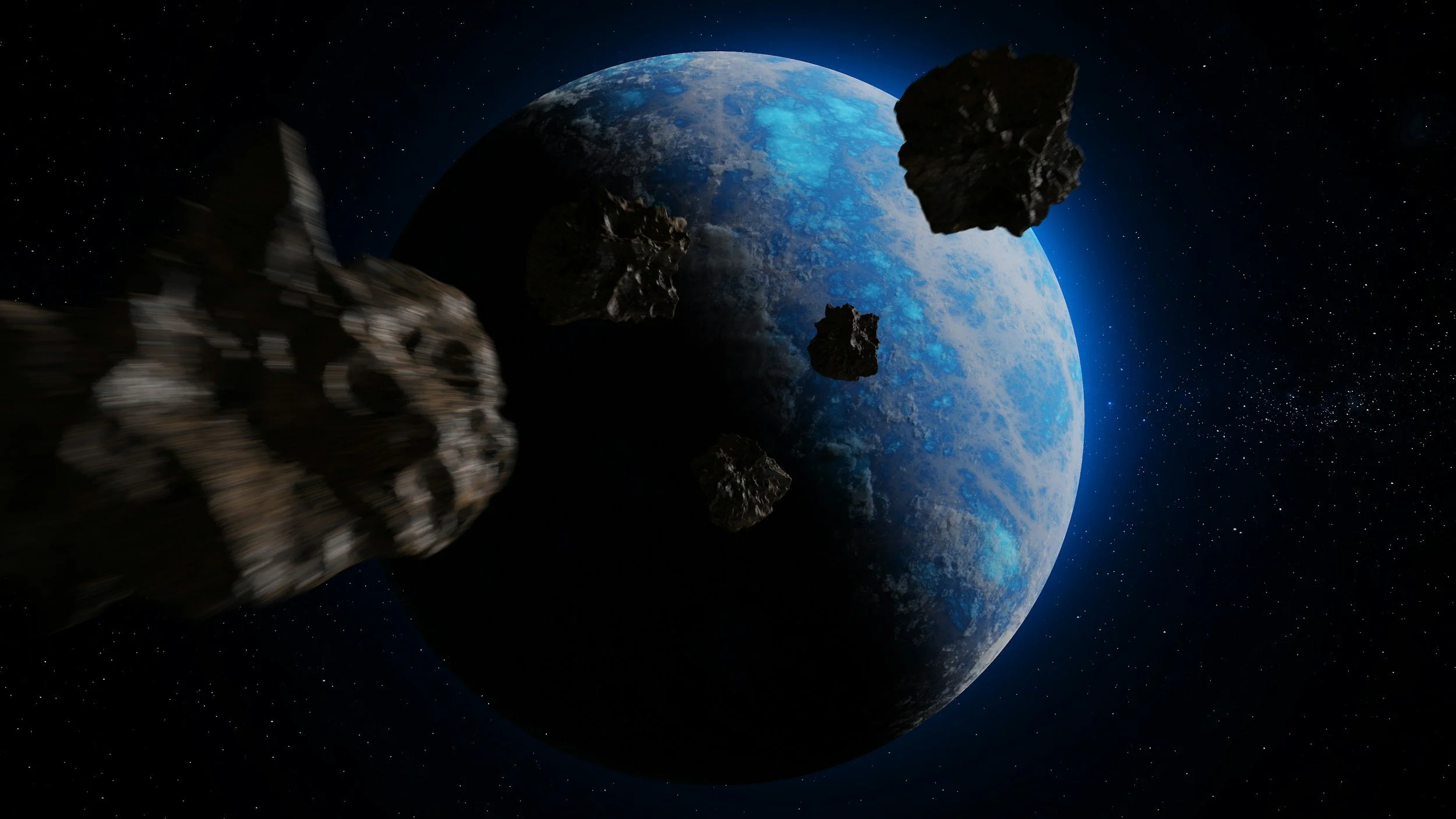
Scientists are learning how to protect Earth from dangerous asteroids. In 2022, the space agency NASA carried out a bold experiment to see if humans could change the path of an asteroid in space.
The mission was called the Double Asteroid Redirection Test (DART). Instead of landing on an asteroid, scientists purposely crashed a spacecraft into one to see if the impact could push it slightly off course.
The target was a small asteroid called Dimorphos. Dimorphos is about 525 feet wide, roughly the height of a tall skyscraper. It orbits a larger asteroid named Didymos, forming what scientists call a binary asteroid system. This means two asteroids are connected by gravity and orbit each other in space.
NASA launched the DART spacecraft in 2021. After traveling through space for about ten months, the spacecraft slammed into Dimorphos at nearly 14,000 miles per hour. Scientists around the world watched closely using telescopes on Earth and in space.
The crash worked even better than scientists expected. The impact shortened Dimorphos’s orbit around Didymos by about 32 to 33 minutes. Before the crash, Dimorphos took about 12 hours to travel around its partner asteroid. After the impact, it began orbiting slightly faster.
The collision also blasted a large cloud of dust and rocky debris into space. This debris actually helped push the asteroid even more. When the rocks flew away from Dimorphos, they created an extra force that gave the asteroid an additional “kick.” Scientists call this effect momentum enhancement.
But new research shows the mission did even more than scientists first thought. The impact did not just change how Dimorphos moves around Didymos. It also slightly changed how both asteroids travel around the Sun.
The change was extremely small. The asteroid system’s orbit around the Sun shifted by about 0.15 seconds per orbit. That may sound tiny, but in space even a small change can grow larger over time. Scientists say a small push applied years in advance could move a dangerous asteroid far enough that it would miss Earth.
To measure this change, scientists used a special observation technique called stellar occultation. This happens when an asteroid passes in front of a distant star and briefly blocks its light. By measuring these short moments when a star disappears, astronomers can calculate the asteroid’s position very precisely.
Dozens of amateur astronomers around the world helped collect this data. Observers in places like Australia, Japan, and the United States watched the asteroid system pass in front of stars and recorded the exact timing. Combined with radar measurements from observatories such as Goldstone, scientists were able to confirm the tiny change in the asteroid system’s orbit.
The asteroids normally travel around the Sun at more than 76,000 miles per hour. The DART impact increased their speed by only about two inches per hour, but that was enough to slightly shift their path.
Importantly, Dimorphos and Didymos were never a threat to Earth. The DART mission was simply a test to see whether asteroid deflection could work in the future.
Scientists are especially interested in this research because many asteroids near Earth have still not been discovered. Experts estimate that around 25,000 asteroids large enough to destroy a city exist near Earth’s orbit. So far, scientists have found only about 40 percent of them, meaning more than 15,000 may still be undetected.
These asteroids can be difficult to find because many are dark and reflect very little sunlight. Others travel close to the Sun from Earth’s point of view, making them harder for telescopes to observe.
A powerful reminder of the danger occurred in 1908 during the Tunguska event. A space rock about 130 feet wide exploded above Siberia, flattening around 830 square miles of forest. If a similar explosion happened above a modern city, it could cause major destruction.
Because of this risk, scientists are working on new tools to detect asteroids earlier. NASA is planning a new space telescope called the Near-Earth Object Surveyor, designed to search for hard-to-see asteroids by detecting the heat they give off.
Meanwhile, another spacecraft from the European Space Agency called Hera is traveling to study Dimorphos and Didymos up close. Hera will measure the crater left by the DART impact and analyze how the asteroid changed after the collision.
Together, these missions are helping scientists learn how to defend Earth from dangerous space rocks. The DART mission marked the first time humans successfully changed the motion of a celestial object in space, showing that if a threatening asteroid is discovered early enough, humanity may have a way to push it safely off course.
References
France 24. 2026. “NASA Successfully Kicks Asteroid Off Course in Earth Defence Test.” France 24, March 7, 2026.
https://www.france24.com/en/science/20260307-nasa-kicked-asteroid-off-course-test-earth-defences-against-space-rocks-dimorphos
Joseph, Jordan. 2026. “NASA Warns That Over 15,000 ‘City-Killing’ Asteroids Are Orbiting Earth Undetected.” Earth.com, March 7, 2026.
https://www.earth.com/news/nasa-warns-that-over-15000-city-killing-asteroids-orbit-earth-undetected/
Miller, Katrina. 2026. “Asteroid-Smashing NASA Mission Sped Up Space Rocks’ Journey Around the Sun.” The New York Times, March 6, 2026.
https://www.nytimes.com/2026/03/06/science/nasa-dart-asteroid-sun-orbit.html
NASA. 2026. “NASA’s DART Mission Changed Orbit of Asteroid Didymos Around Sun.” NASA, March 6, 2026.
https://www.nasa.gov/missions/dart/nasas-dart-mission-changed-orbit-of-asteroid-didymos-around-sun/