
Pluto: The Dwarf Planet
Pluto: The Dwarf Planet
Written by: Zeenia Bharucha
If someone asked you “How many planets are in our solar system?”, would you say eight or nine? There has been an ongoing debate about whether Pluto is considered a planet or not. In 2006, the International Astronomical Union (IAU) reclassified Pluto as a dwarf planet, creating more confusion than ever before. Even though it is no longer considered a planet, Pluto remains one of the most fascinating objects in our solar system. Let’s explore why Pluto lost its planet status and discover what makes this dwarf planet so special.
Pluto lies in the Kuiper Region, an area full of icy bodies and other dwarf planets at the edge of our solar system. Pluto orbits around the Sun at an average distance of about 3.6 billion miles (5.9 billion kilometers). Because it is so far away, sunlight on Pluto is much dimmer than it is on Earth. If you stood on Pluto at noon, the Sun would look like a bright star instead of the large, glowing Sun we see here on Earth.
Pluto was discovered on February 18, 1930, by an American astronomer named Clyde Tombaugh. Since Pluto shares its neighborhood with many other icy objects instead of clearing its orbit, it was reclassified as a dwarf planet. Even though its title has changed, Pluto is still an important part of our solar system.
One day on Pluto lasts a little over six Earth days because it spins very slowly. A single year on Pluto is much longer, it takes about 248 Earth years to travel around the Sun just once! That means Pluto has not even completed one full orbit since it was discovered in 1930.
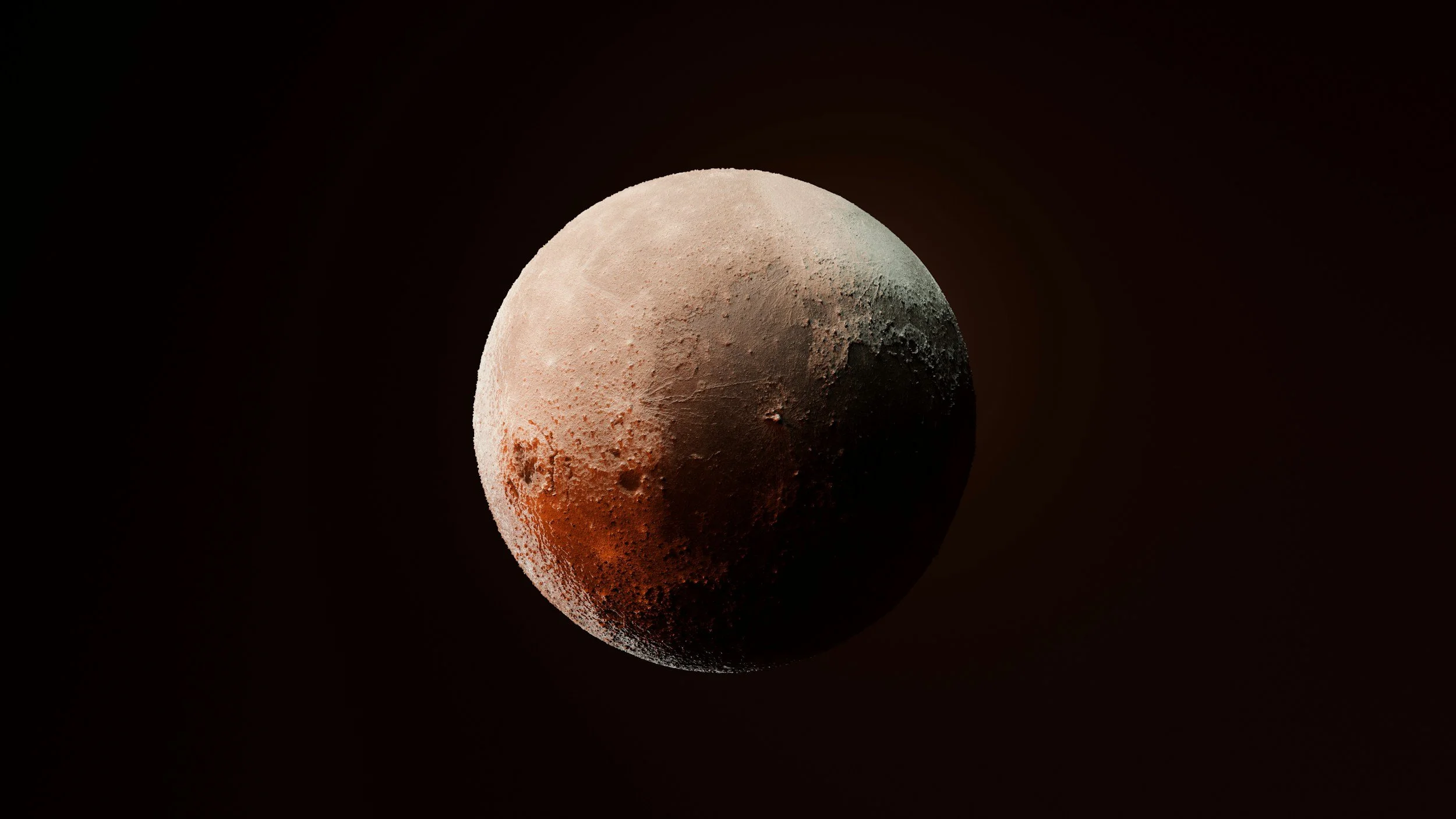
Pluto is an incredibly cold place. Temperatures can drop to around -375°F (-225°C). The surface of the planet is covered with frozen nitrogen, methane, and carbon monoxide ice. Scientists have also discovered mountains made of water ice that can rise as high as the Rocky Mountains!
Pluto has five known moons. The largest moon is named Charon, and it is so large compared to Pluto that the two worlds orbit around a point in space between them. Pluto’s four smaller moons are called Styx, Nix, Kerberos, and Hydra. These tiny moons have unusual shapes and move in interesting ways around Pluto.
Although Pluto is small, it still continues to surprise scientists. Studying Pluto helps researchers learn more about how the solar system formed billions of years ago. Every new discovery reminds us that even the smallest worlds can hold big mysteries.
Fun Facts About Pluto
Pluto is named after the Roman god of the underworld
Pluto has a reddish color because chemicals called tholins form on its surface when sunlight reacts with its icy gases
Plutos gravity is so weak that if you weighed 100 pounds on Earth, you would only weigh about 6 pounds on Pluto
Scientists believe Pluto may have a hidden ocean of liquid water beneath its icy surface
References
Encyclopaedia Britannica. n.d. "Pluto." Accessed July 5, 2026. https://www.britannica.com/place/Pluto-dwarf-planet.
National Aeronautics and Space Administration (NASA). n.d. "New Horizons." Accessed July 5, 2026. https://science.nasa.gov/mission/new-horizons/.
National Aeronautics and Space Administration (NASA). n.d. "Pluto." Accessed July 5, 2026. https://science.nasa.gov/pluto/.