
Humanoid Robot Outruns Humans in Half Marathon
Humanoid Robot Outruns Humans in Half Marathon
Written by: Keya Gambhir
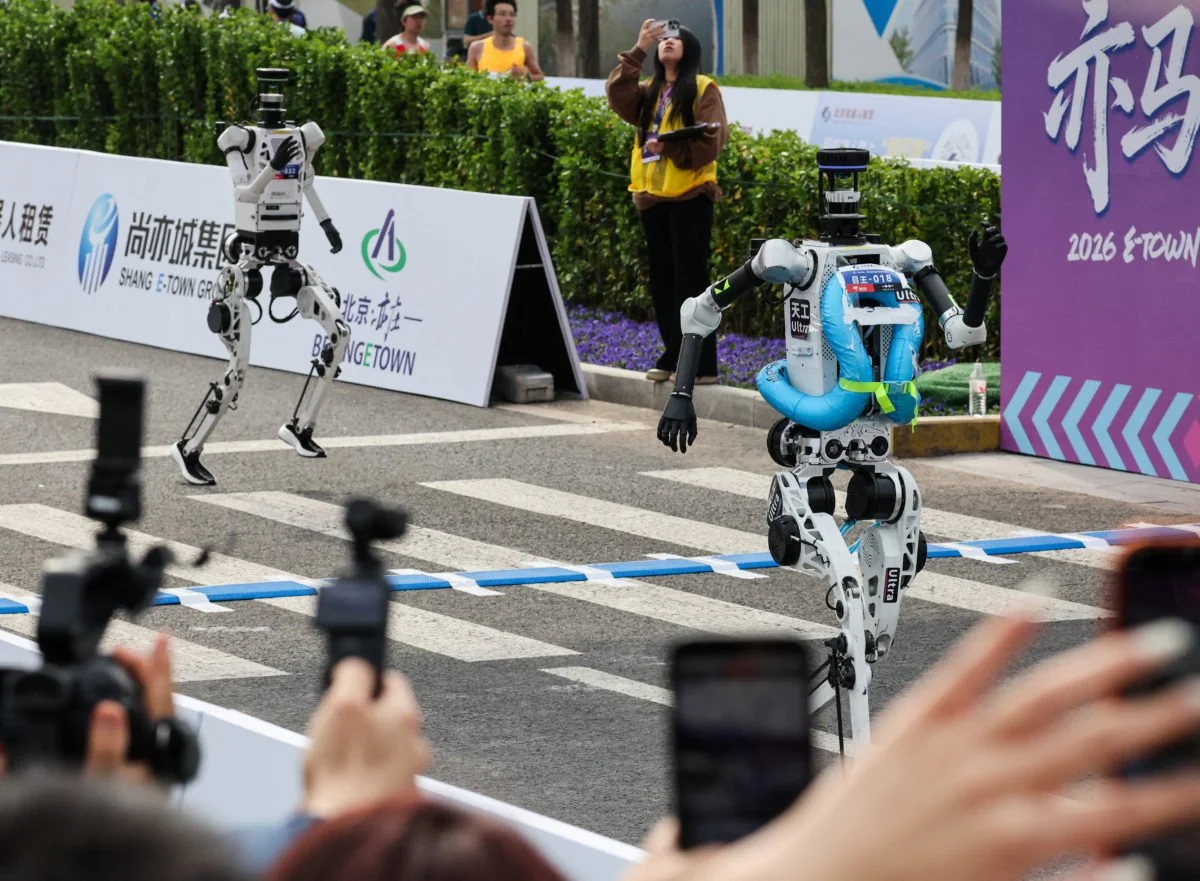
In a race that looked like it came straight out of a science fiction movie, humanoid robots ran a half-marathon in Beijing, China, and one robot even finished faster than the human world record. The event shocked people around the world and showed just how quickly robot technology is improving.
The race took place in April 2026 in an area called Beijing E-Town. More than 100 humanoid robots joined about 12,000 human runners for the 13.1-mile race, also known as a half-marathon. To keep everyone safe, the humans and robots ran in separate lanes.
The biggest star of the race was a bright red robot named Lightning. Lightning was created by the Chinese smartphone company Honor. The robot stood about 5 feet 5 inches tall and had very long legs designed to copy the movements of elite athletes.
Lightning completed the race in an amazing 50 minutes and 26 seconds. That time was faster than the human world record set by runner Jacob Kiplimo, who ran the same distance in 57 minutes and 20 seconds in March 2026.
Even though the robot won, the race was not perfect. Near the end of the course, Lightning crashed into a barrier and fell. With some help from humans nearby, the robot stood back up, regained balance, and finished the race. Other robots also had problems. One fell right at the starting line, and another bumped into a wall during the race.
Still, many people were amazed by how much robots had improved in only one year. During the first robot half-marathon in 2025, the winning robot needed almost three hours to finish. This year, several robots finished faster than professional human athletes.
One reason Lightning was so fast was because of special technology inside its body. Engineers equipped the robot with a liquid cooling system similar to the cooling systems used in smartphones and computers. Cooling systems help machines avoid overheating while working hard for long periods of time. The robot’s long legs also helped it take bigger steps, just like top runners do.
Another impressive detail was that many of the robots could move on their own without humans controlling them. Around 40 percent of the robots used autonomous navigation, meaning they could “think” about where to run using sensors and computer programs. Some other robots were controlled remotely by people.
People watching the race could hardly believe what they were seeing. A spectator named Sun Zhigang told reporters that he never imagined robots would someday run faster than humans. Another viewer said it felt like the beginning of a “new era.”
Scientists and engineers believe races like this are important because the technology used in robots can help people in many ways. For example, the cooling systems and strong robot structures could someday be used in factories, hospitals, or dangerous rescue missions. Robots may eventually help carry heavy objects, assist elderly people, or work in places that are too risky for humans.
China has been investing heavily in robotics and artificial intelligence. The country sees technology as an important part of its future and wants to become a world leader in advanced robotics. Companies like AGIBOT, Unitree Robotics, and UBTech Robotics Corp. are already producing thousands of humanoid robots each year.
Even though robots can now run incredibly fast, humans still have something special that machines do not. Human runners train for years with determination, teamwork, and emotion. Robots may beat records, but they cannot feel excitement, pride, or the joy of crossing the finish line after months of hard work.
For now, robot races are mostly exciting experiments and a chance to test new inventions. But after seeing robots sprint through a half-marathon faster than world-class athletes, many people are wondering what robots might be able to do next.
References
Adeel Hassan. 2026. “Humanoid Robot Wins Half-Marathon and Smashes Humans’ Record.” The New York Times, April 19, 2026. https://www.nytimes.com/2026/04/19/world/asia/running-robot-sets-record.html.
Andrew Gregory. 2026. “Humanoid Robots Show Rapid Advances as They Race Past Humans in Beijing Half Marathon.” The Guardian, April 19, 2026. https://www.theguardian.com/sport/2026/apr/19/humanoid-robots-race-beijing-half-marathon.
“Humanoid Robot Wins Beijing Half-Marathon, Defeating the Human World Record.” 2026. PBS NewsHour, April 19, 2026. https://www.pbs.org/newshour/world/humanoid-robot-wins-beijing-half-marathon-defeating-the-human-world-record.
“One Year Later: Robots Outrace Humans.” 2026. News for Kids, May 7, 2026. https://newsforkids.net/articles/2026/05/07/one-year-later-robots-outrace-humans/.