
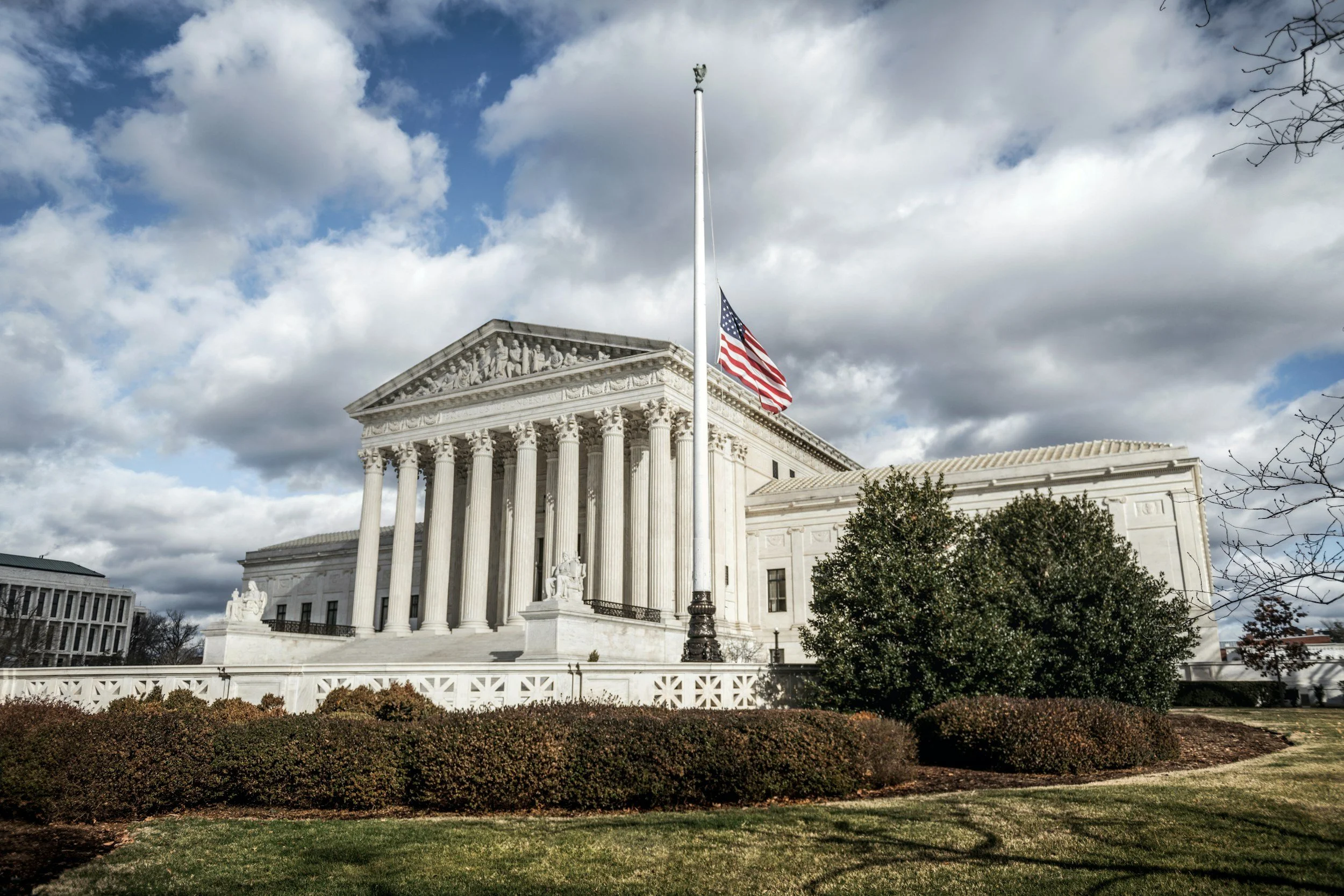
Supreme Court to Decide on Birthright Citizenship Order
Supreme Court to Decide on Birthright Citizenship Order
Written by: Keya Gambhir
The United States Supreme Court has agreed to hear a case about birthright citizenship, a rule that says most children born in the U.S. automatically become American citizens. This comes after President Donald Trump signed an executive order trying to change this rule for certain children.
President Trump’s order, signed on his first day back in office, says that children born to people who are in the U.S. illegally, or on temporary visas, would not automatically become citizens. This order challenged a long-standing understanding in the United States: that nearly everyone born on American soil is a citizen. Before the order could be enforced, several federal courts blocked it, saying it could be unconstitutional. One judge even called it “blatantly unconstitutional.”
The Supreme Court will now decide if President Trump’s order is legal. The Court has not announced a date for oral arguments yet, but it is expected to hear the case in the next few months and give a decision. Lower courts had paused the policy across the country, but the Supreme Court’s previous ruling dismissed their authority and allowed President Trump’s administration to continue arguing for the order while the case proceeds.
The case is based on the 14th Amendment to the U.S. Constitution. This amendment guarantees citizenship to “all persons born or naturalized in the United States.” The Supreme Court will have to decide whether this constitutional promise applies to all children born in the country, or if the president can limit it through an executive order.
Advocacy groups and public officials have already spoken out about the case. The immigration group Fwd.US said the order is “unlawful.” Its president, Todd Schulte, said that birthright citizenship is a core part of being American. He explained that it guarantees equality under the law for all children born in the country, and that trying to take it away could create confusion and harm for families.
New York Attorney General Letitia James also described birthright citizenship as “a fundamental right of our Constitution.” She emphasized that constitutional rights cannot be changed by a president’s decision.
A key part of the case will be the arguments, such as those made by U.S. Solicitor General D. John Sauer. Sauer, who argues that the 14th Amendment was originally “adopted to confer citizenship on the newly freed slaves and their children, not on the children of aliens temporarily visiting the United States or of illegal aliens.” This view suggests that the amendment’s promise of citizenship may not apply as broadly as many people have long believed, and it will be up to the Supreme Court to decide whether this interpretation is correct.
This case is seen as very important because it could affect hundreds of thousands of children born in the United States every year. The Supreme Court’s decision will clarify whether the president has the power to change how citizenship is given, or if the 14th Amendment continues to apply to all children born on U.S. soil.
Although the Court has agreed to review the case, it has not yet set a specific schedule for hearings. Experts expect the process could take several months, and the decision could be announced by the middle of next year. People on both sides of the issue are watching closely because the ruling could affect immigration policy, families, and legal definitions of citizenship for a long time.
For now, children born in the United States remain citizens under current law. The Supreme Court’s review will decide whether the rule changes for some children or remains the same.
References
BBC News. 2025. “US Supreme Court Agrees to Hear Case Challenging Birthright Citizenship.” December 5. https://www.bbc.com/news/articles/c208j0wrzrvo.
Cullen, Matthew. 2025. “Justices to Review Trump’s Order Restricting Birthright Citizenship.” The New York Times, December 5. https://www.nytimes.com/2025/12/05/briefing/supreme-court-birthright-citizenship.html.
FWD.us. “FWD.us Statement on So‑Called ‘Review’ of Vetted and Resettled Refugees in the U.S.” December 1, 2025. https://www.fwd.us/news/fwd-us-statement-on-so-called-review-of-vetted-and-resettled-refugees-in-the-u-s/
FWD.us. “FWD.us Statement on Supreme Court Hearing Regarding Birthright Citizenship.” May 15, 2025. https://www.fwd.us/news/fwd-us-statement-on-supreme-court-hearing-regarding-birthright-citizenship/
Mackey, Robert, Dani Anguiano, Lucy Campbell, Maya Yang, and Vivian Ho. 2025. “Supreme Court Urged to Uphold Birthright Citizenship as Justices Agree to Decide Legality of Trump Crackdown – US Politics Live.” The Guardian, December 5. https://www.theguardian.com/us-news/live/2025/dec/05/trump-pete-hegseth-signal-politics-updates.