
Does Earth have a Second Moon?
Does Earth have a Second Moon?
Written by: Keya Gambhir
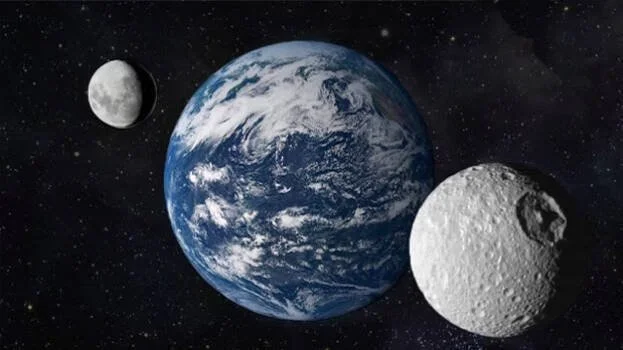
If you’ve seen people online saying Earth just got a second moon, don’t be fooled. Earth still has only one real moon, the big gray one we see glowing in the night sky. But recently, astronomers found something new that’s almost like a moon. It’s a small asteroid called 2025 PN7, and it travels close to Earth as we both orbit the Sun.
What Is a Quasi-Moon?
2025 PN7 is not a “true” moon but something called a quasi-moon. The word “quasi” means “almost,” which fits perfectly because quasi-moons are almost like moons. They seem to orbit Earth, but they don’t. Instead, they orbit the Sun, just like Earth does.
From our point of view, these objects look like they are looping around our planet, but they’re really just moving in a path that stays close to Earth. It’s a bit like two cars driving side by side on a racetrack. One might look like it’s circling the other, but both are actually traveling in the same direction.
How 2025 PN7 Was Discovered
Astronomers first spotted 2025 PN7 in August 2025 using the Pan-STARRS Observatory in Hawaii. They reported it to the Minor Planet Center, which officially tracks asteroids and comets.
Even though it was only just discovered, scientists think 2025 PN7 has been following Earth for about 60 years. The asteroid is tiny, around 62 feet wide, roughly the size of a basketball court. Because it’s so small and not very bright, telescopes had a hard time detecting it until this year.
Experts say 2025 PN7 will probably stick around for another 60 years, staying close to us until around the year 2083, when the Sun’s gravity will eventually pull it away.
Is 2025 PN7 Dangerous?
No. Astronomers say 2025 PN7 poses no danger to Earth. It’s far enough away that it can’t crash into us or affect our gravity. Think of it as a harmless space neighbor quietly traveling beside us.
Although it’s small and distant, 2025 PN7 gives scientists a great chance to study how gravity affects asteroids. Quasi-moons are also exciting targets for future space missions since they’re much closer to Earth than most other asteroids.
Clearing Up the “Second Moon” Rumors
So where did all the “Earth has two moons” talk come from? After the discovery, social media users began spreading claims that NASA had confirmed a second moon. But that’s not true. NASA only confirmed that 2025 PN7 is a quasi-moon, not a real one.
Earth’s one and only true moon is about 2,159 miles wide and sits 239,000 miles away. It’s been orbiting our planet for billions of years. Quasi-moons like 2025 PN7 are much smaller and move around the Sun, not around Earth.
Mini-Moons vs. Quasi-Moons
You might have also heard about a “mini-moon” called 2024 PT5 that appeared last year. Mini-moons are different from quasi-moons. Mini-moons actually get caught by Earth’s gravity for a short time and orbit our planet directly. They are temporary visitors, usually staying for only a few months before drifting away again.
The mini-moon 2024 PT5 circled Earth briefly between September and November 2024 before being pulled back into space. Scientists believe it may have even been a small piece of our actual Moon that broke off long ago.
Quasi-moons like 2025 PN7, on the other hand, never get trapped by Earth’s gravity. They travel in their own paths around the Sun but remain close to Earth for decades.
Why Astronomers Care About Quasi-Moons
Quasi-moons might sound small and unimportant, but they can help scientists learn a lot about space. They reveal how gravity, speed, and distance affect the motion of objects near Earth. Studying them also helps researchers understand how to track asteroids that could come closer to our planet in the future.
Because they’re nearby, quasi-moons could be great testing grounds for future spacecraft. Space missions could visit them to practice landing, collect samples, or test new exploration tools without having to travel too far from home.
A Cosmic Companion
So, does Earth have two moons? Not really. Our planet still has just one true Moon. But the discovery of 2025 PN7 shows that we have some interesting company out there.
This small asteroid is like a cosmic friend, quietly keeping pace with us as we both circle the Sun. It reminds scientists that our solar system is always changing and full of surprises waiting to be found.
The next time someone says Earth has a new moon, you can tell them the real story. It’s not a second moon, it’s a tiny asteroid that’s been traveling beside us for decades, just along for the ride.
References
Adams, Abigail. 2025. “A New 'Quasi-Moon' Has Been Discovered Near Earth and Will Stick Around for Another 60 Years.” People, October 25. https://people.com/new-quasi-moon-discovered-near-earth-11836992.
Bebernes, Mike. 2025. “Does Earth Have a New Moon? Not Quite.” Yahoo News. https://www.yahoo.com/news/articles/does-earth-moon-not-quite-161955669.html.
Blazek, Jonathan, and Jacqueline McCleary. 2025. “Earth Could Have Six More ‘Quasi-Moons’ Like 2025 PN7.” Northeastern University News, October 22. https://news.northeastern.edu/2025/10/22/earth-second-moon-astrophysicists-talk-discovery/.
ToppersNotes. 2025. “Earth’s Fake Moon: This Quasi-Moon Has Circled Earth Since at Least 100 BC and Will Continue to Do So.” ToppersNotes, October ? https://toppersnotes.co/current-affairs/blog/earths-fake-moon-this-quasi-moon-has-circled-earth-since-at-least-100-bc-and-will-continue-to-do-so-11Cf.
USA Today Staff. 2025. “Earth Quasi-Moon Asteroid Discovered.” USA Today, October 22. https://www.usatoday.com/story/news/nation/2025/10/22/earth-quasi-moon-asteroid/86819532007/.