
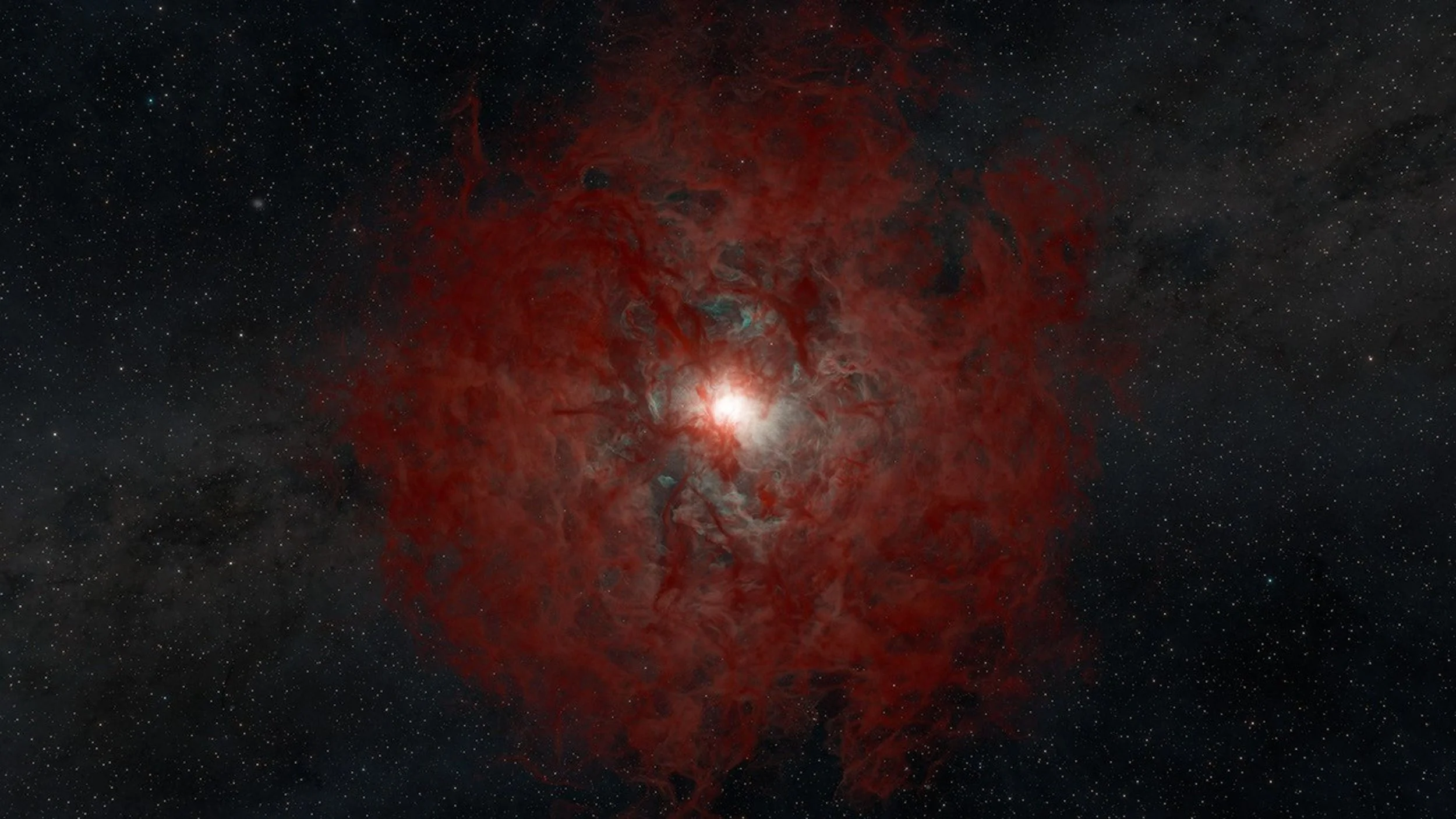
Star in Andromeda Galaxy Collapses Directly Into a Black Hole
Star in Andromeda Galaxy Collapses Directly Into a Black Hole
Written by: Keya Gambhir
Astronomers have discovered some of the clearest evidence yet of a star collapsing directly into a black hole without exploding in a supernova. The star, called M31 2014 DS1, was located in the Andromeda Galaxy, about 2.5 million light-years from Earth.
Most massive stars are expected to end their lives in a powerful explosion known as a supernova. During a supernova, the core of the star collapses and releases a flood of tiny particles called neutrinos. These particles help drive a shockwave that blasts the outer layers of the star into space. Supernovae are extremely bright and can briefly outshine an entire galaxy.
However, M31 2014 DS1 did not explode.
In 2014, NASA’s NEOWISE space telescope detected that the star was growing brighter in infrared light, which is invisible to the human eye but detectable with special instruments. The infrared glow continued for about three years. By 2023, the star’s visible light had dimmed by more than 10,000 times, and it effectively disappeared, leaving behind a cloud of hot gas and dust.
Scientists concluded that the star underwent what is known as a direct collapse, sometimes called a failed supernova. Instead of producing a strong enough shockwave to push its outer layers outward, the star’s core ran out of fuel and collapsed inward under its own gravity. Most of the star’s material fell inward as well, forming a black hole.
When it was young, M31 2014 DS1 was about 13 times the mass of the Sun. Over time, it lost much of its mass through strong stellar winds and had shrunk to about five times the Sun’s mass by the time it died. Stars in this mass range were long believed to always explode as supernovae, making this discovery especially important.
The research team analyzed archival data from NASA’s NEOWISE mission, which stands for Near-Earth Object Wide-field Infrared Survey Explorer. Although NEOWISE was designed mainly to search for asteroids, it also collected valuable infrared observations of stars and galaxies. Scientists combined this data with observations from other space and ground-based telescopes collected between 2005 and 2023.
The idea that stars could collapse directly into black holes without exploding was first proposed in the 1970s. Researchers predicted that such an event would produce a faint infrared glow as the star shed its outer layers and became surrounded by dust. The observations of M31 2014 DS1 closely matched those predictions.
A possible similar event may have been observed years ago in another galaxy called NGC 6946. However, that event was much fainter and harder to confirm. The new findings provide stronger evidence that direct collapse can occur.
This discovery suggests that some massive stars may quietly form black holes without dramatic explosions. As astronomers continue studying archival data and searching the skies, they may find that this type of stellar death is more common than previously thought.
References
Columbia University. 2026. “Astronomers Trace a Star’s Three-Year Infrared Glow to Black Hole Birth.” Phys.org, February 14, 2026. https://phys.org/news/2026-02-astronomers-star-year-infrared-black.html.
National Aeronautics and Space Administration (NASA). 2026. “Archival Data From NASA’s NEOWISE Tracks Star Turning Into Black Hole.” NASA Science, February 12, 2026. https://science.nasa.gov/blogs/science-news/2026/02/12/archival-data-from-nasas-neowise-tracks-star-turning-into-black-hole/.
Todd, Iain. 2026. “Scientists Get Clearest View Ever of Star Collapsing Into a Black Hole. And They Very Nearly Missed It.” Sky at Night Magazine, February 15, 2026. https://www.skyatnightmagazine.com/news/m31-2014-ds1-black-hole.