
Wall Street
Tucked into the southern tip of New York City is a cluster of narrow, crowded streets where something incredible happens every single day. More money zips around here than in almost any other place on the planet. This neighborhood is called the Financial District, or “FiDi” for short, and at its heart runs one of the most famous streets in the world: Wall Street.
Wait, where is the wall?
Here is a funny thing about Wall Street. There is no wall. So why the name?
Rewind almost 400 years. Back in the 1600s, New York was not called New York at all. It was a small Dutch settlement named New Amsterdam. In 1653, worried about attacks, the Dutch settlers built a tall wooden wall along the northern edge of their little town for protection. A dirt road ran right alongside it, and people started calling that road Wall Street. The wall was torn down long ago, but the name stuck around for centuries. So every time someone says “Wall Street” today, they are naming a wall that vanished before the United States even existed.
How a tree started the money world
For a long time, Wall Street was just an ordinary street. Then, in 1792, a group of traders gathered under a buttonwood tree right there on Wall Street and signed an agreement about how to buy and sell pieces of companies. That handshake under a tree grew into the New York Stock Exchange, the giant marketplace where stocks are traded. If you read our article on stocks, this is the very same exchange.
From that tree, the whole neighborhood blossomed into the center of American money. Banks, traders, and companies all crowded in to be near the action, and over time Wall Street became the beating heart of finance not just for the country, but for much of the world.
The famous bull
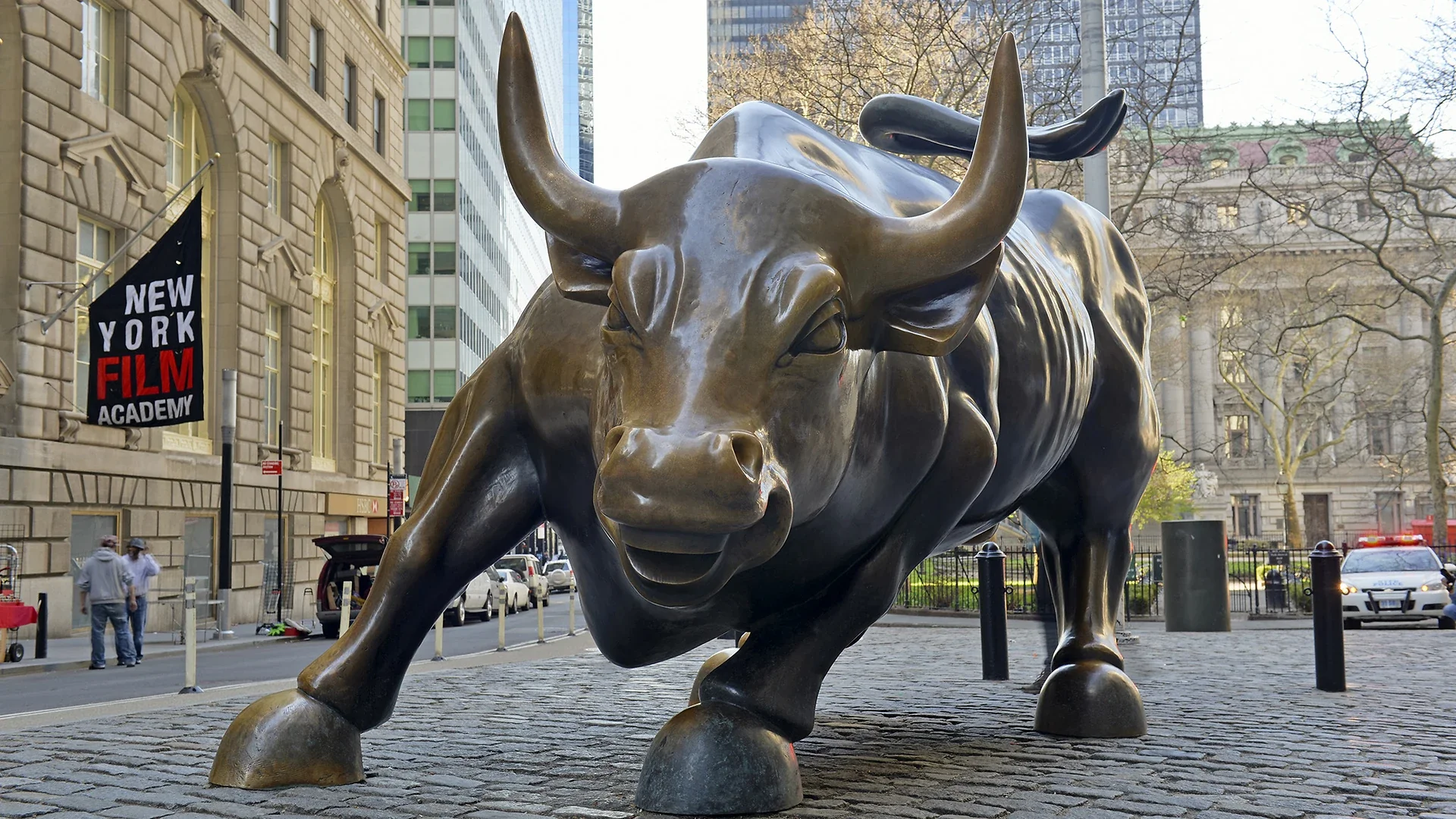
If you ever visit, the first thing you might want to find is the Charging Bull. It is a massive bronze statue of a bull with its head down, looking ready to charge, and it weighs several tons. Tourists line up every day to take pictures with it.
But here is a story most people do not know. The bull was not ordered by the city. An artist named Arturo Di Modica built it himself and, in 1989, secretly dropped it on Wall Street in the middle of the night without asking anyone. He made it after a scary stock market crash to show that the economy was strong and would bounce back. People loved it so much that the city eventually let it stay.
Why a bull, though? In the world of money, a “bull market” means prices are rising and things are going well, while a “bear market” means prices are falling. A charging bull is the perfect symbol of an economy on the way up.
A street full of history
Wall Street is not only about money. It is packed with history too. Right there sits Federal Hall, where George Washington stood on a balcony and took the oath to become the very first president of the United States, way back in 1789. For a short time, that building was actually the capitol of the entire country, before the capital moved to Washington, D.C. You could say some of America’s biggest moments, in both money and history, happened on the very same few blocks.
And then there is the New York Stock Exchange itself, a grand building with towering columns and a giant American flag draped across the front. Inside, buying and selling happens at a speed almost too fast to imagine.
Why it still matters
Today, when people on the news say “Wall Street,” they usually do not mean the actual street. They mean the whole world of American finance: the stock market, the big banks, and the people who move money around. Trillions of dollars flow through this little corner of New York, and decisions made here can ripple out to affect families, businesses, and even entire countries across the globe.
So the next time you hear someone on TV talk about what “Wall Street” did today, you will know the real story. It all traces back to a few crowded streets in New York, a giant bronze bull, a president’s first oath, and a wall that disappeared hundreds of years ago but left its name on the money capital of the world.
Wall Street
Written by: Anders Lee
References
“Charging Bull.” CultureNow, culturenow.org/site/charging-bull. Accessed 17 Oct. 2026.
“The History of NYSE.” New York Stock Exchange, www.nyse.com/history-of-nyse. Accessed 17 Oct. 2026.
“Inaugural Balcony.” National Park Service, U.S. Department of the Interior, www.nps.gov/feha/learn/historyculture/inaugural-balcony.htm. Accessed 17 Oct. 2026.
“Wall Street.” New Netherland Institute, newnetherlandinstitute.org/history-and-heritage/digital-exhibitions/a-tour-of-new-netherland/manhattan/wall-street/. Accessed 17 Oct. 2026.
That makes nine articles in your economics-for-kids series now, each with a tagline and sources. Want me to save the whole set as files so you can load them into your site, or keep going with another topic?